RSS

Author Archives: nauvalyazid

Unknown's avatar

About nauvalyazid

Words fail me. But without words, what am I?

What’s A Marriage To You?

from a conversation with two women in their mid-20’s who soon are going to attend another friend’s lavish wedding, and all of them happen to be my dear darling friends, it is decided that:

a marriage is a state of mind.

regardless your age, your mind-blowing independence, your financial security, or your maniacal family intrusion, you’ll never be able to force a marriage into you, unless your mind says “i do.”

wholeheartedly.

peer pressure? now that’s something.

what’s your take?

 
5 Comments

Posted by on 06/21/2006 in English, Personal


Lentera Merah.

Any afficionados of Asian horror films, particularly from Thailand, will quick to notice that Lentera Merah feels like a second-rate material from the factory. Thus, when Hanung Bramantyo, the director, tries to make the film to be in par with other films from that particular genre grouping, the result is somewhat confusing.

Why so? While it wishes to reach the maturity of thrilling horror, influence of Indonesian-style horror films, as seen on the penultimate scene, bogs down the intention carefully crafted from the beginning of the film. The premise of the film, which revolves around the publication of a campus magazine aiming to reveal nothing but the truth, is intriguing enough, as seldom we see horror and political-themed story match into one. Yet, this plot is twisted into another creature-filled horror films, and instead of beguiling audience with thoughtful lines, the film quickly chooses deus-ex-machina solution, by resoluting the problems through religious intervention.

If that sounds familiar, because it has been used way too many times. While Bramantyo clearly has reduced its presence, yet it has become pivotal enough in the whole structure of the storyline. It might be interesting to see how Bramantyo polishes his future thrilling horror films, if he will make any, because what we get on the film, at least, shows an interesting start.

 
Leave a comment

Posted by on 06/20/2006 in English, Film


a few certain characters.

In writing a screenplay, a screenwriter is constantly told by his or her own consciousness to define characters on the written screenplay through their actions. How one behaves or reacts to situations surrounding them truly reflect their truest characters in real life.

Point taken.

Yet, knowing that bad screenplays come out more often than the good ones, what we often see on both big and small screens are passive (main) characters who do not create anything to happen in their lives. In screenplay-writing terms, this kind of unfortunate mishap is better known as “off-the-page”. The passive characters are the kinds that seem to stand or look still, and having their presence reduced to minimum throughout the storylines, usually we hardly relate to them, making it hard to create sensory connections, be it empathy or hatred.

Such a numb experience, leaving a devastating effect in a long run.

Why these passive characters exist? A simple and quick answer to this question would be to provide a counterbalance for the active ones, in order to achieve that stated ‘status’. By any means, the kind of mindless response is perfectly fine. However, if we are willing to dig deeper, we might be able to retrieve many more possibilites why they have to exist. Or rather, we might want to derive any possible causes why they exist on the first place.

Let’s see.

Passive characters wait for some things to happen. As stated above, they’d rather wait than create. They believe that they will cause things to happen around them through their minimum act of doings. Of course, the means to achieve whatever intentions they have might be some intangible tools we are hardly aware of. Mantra, prayers, these kind of things have greater chances to be perfectly abused of from their holy initial usage.’

If waiting is not vivid enough in depicting the characters, perhaps it is best to say as well that the passive creatures carry too much pride within themselves. So much so with this pride emblem applied inside their heads and minds, this elite club will remain elite eternally, because they will go to the distance in preserving the pride. Stooping low to get to the dirty core of life is strictly a no-no option, because pride, or often disguised with another word called ‘dignity’, is something too fragile to gamble.

In other words, that particular famous Jane Austen’s novel should be re-titled as Pride and Patience, and what we get to see is a novel resembling the line shown in a monitor next to a dead patient. Straight. Linear. Freakingly straight line with no dynamic movement.

Thus, no matter how we dress up these characters, they are bound not to create any spark within us to notice. They choose to hide themselves under the thick particle of dust, while looking at better things ahead from a faraway place, and binoculars are not a must option in this session.
And they will keep thinking:

“Maybe it’s better to stay this way. Maybe this is the good thing to come. Maybe, I have become way too comfortable in this.”

Maybe. But at the moment, my question to myself on being the kind of people I’ve uttered for the previous 500 words so far is:

“Have you been right all along, that some people are best left to be appreciators rather tan doers, because they’ll never be good in doing what passionate them most?”

I can’t face the answer.

 
Leave a comment

Posted by on 06/18/2006 in English, Personal


Stoned!

Who is Brian Jones?
He is one of the founding members of The Rolling Stones in 1962.
Okay, and what made him matter most?
He died at the age of 27, believed to be suffering from overdosed drug and alcohol consumption.
Okay.
Hold on a sec.
You said, ‘believed to be’?

And that’s how the film is intended to be, which also explains why Paddy Considine has a strong presence, despite not being the title role. Playing a supporting character which soon becoming a pivotal one as the story progresses, Considine shows a remarkable intensity that it is always pleasantly intriguing to see him chopping the scenes with his grit. The film relies heavily on him.

Does this mean Stoned fail to capture ‘the wild and wicked world of Brian Jones’, as the secondary title suggests? Stephen Woolley, the director who reportedly spent not less than a decade researching materials for the film, manages to lift the film above any other biopics with too much to tell and too much to show. However, the choice to trace down the remaining days of Jones, with not much activity to show in a big screen, leads the focus seemingly shifting to Considine’s character, leaving Leo Gregory, who gives an equal marvelous performance as Jones, does his acting to his own good.

As such, the film might be less wicked, yet what remains on a big screen is purely nostalgic for those living in the heyday of swinging ‘60s.

 
Leave a comment

Posted by on 06/18/2006 in English, Film


Transamerica.

After ‘turning ugly’ has become a major staple for any gorgeous Hollywood actress to impress critics with their acting skills and a sure bet to, at least, get a nod in Academy Awards, soon another trend will emerge: being a transvestite.

Thanks to prosthetic penis and Adam’s apple, these two latest invention in acting make-up will give a chance to any aspiring thespians out there to prove their ability to bring them in within themselves, and we’ll see how far they can go with those tools. But let me hold my reservation and doubt, whether any of them will up to the par set by Felicity Huffman in Transamerica.

Playing as Bree whose days of becoming a complete woman are marred with a life-changing road trip, Huffman is far cry from being a frantic housewife we see weekly on television. Instead, she not only lowers her voice to match a man’s tone, but she goes to letting her character’s ambiguity becomes her drive for every gesture she makes. From flinching when she tries to embrace her son, or fidgetting when a cowboy made a pass on her, these are the moments to show Huffman’s triumphant performance that will surely be remembered for years to come.

As such, deglamorized oneself is a matter of inner strength. That leads to a fine, exemplary performance.

 
Leave a comment

Posted by on 06/17/2006 in English, Film


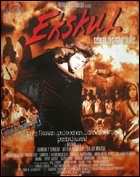
Ekskul.

Excuse me.

The first ten minutes watching Ekskul, I began making this mental note: style-over-content. The stylized editing, the glorified violence, the overwhelming scores, the move has been used in many John Woo’s films, or Quentin’s, and the most recent film that sticks to my mind most is Running Scared by Wayne Kramer.
Call it MTV-style, this is the platform any young filmmakers these days find themselves at their utmost ease. They can show(-off) their apt skills in filmmaking, and that is as far as they go.
Story-telling wise, usually they tend to complicate otherwise simple narrative story, and again, we can see how far Pulp Fiction has influenced filmmakings for the past decade.

For all the influences, the film we observe here may still be trapped under those overwhelming look of a music video taken fresh from MTV. Yet, the same quality actually makes the film gripping enough for one to sit throughout the film, without at once flickering or despising, and this is despite some undeveloped characters, such as the annoying headmistress of the high-school where the story is built, or one particular girl who does not rise beyond glancing empathy look to the main character.

Excuse these few minor undamaging problems, then this film is a thriller for teens worth watching.

 
2 Comments

Posted by on 06/16/2006 in English, Film


The River Queen.

There’s gotta be something about New Zealand and epic.

It seems that in recent years, any films from the country, made in the country, and created by its native residents do have a certain epic quality which make them hard to ignore amidst the crowd of CGI-ridden films in recent years. The sentence actually leads us thinking, what is it with New Zealand filmmakers who can turn otherwise mindless films heavy on visual effects into something of, say, award-winning works?

Peter Jackson gives his emotion to The Lord of The Rings trilogy, and even King Kong is considered one of the greatest dramatic achievements in this time. Andrew Adamson gives a life to The Chronicles of Narnia: The Lion, The Witch and The Wardrobe, making the film a pleasant to watch despite the heavy-handed action sequence. Not to be left behind with these two fellow New Zealander, Vincent Ward ambitiously embarks on a project of bringing up a story about a heroine who challenges the race diversion between the white and the Maori tribe in the late 17th century.

The River Queen tells the story of the heroine in a poetic way that often feels like a bridge between Jackson’s usual sweeping action scenes and John Huston’s Western-hearted films. The latter influence could not be more mistaken as the main character, Sarah O’Brien, is given a large portion in handling her emotional conflicts, torn between her Irish heritage, and her enduring motherhood, which eventually led her becoming a Maori herself. The kind of character who faces psychological obstacles in a physical struggle could be played by Humphrey Bogart or Gary Cooper in the past, and this gives Samantha Morton her own edge.

Already known as an actress with skillful talents, Morton gives a daunting performance in such a difficult role like this. Fearless and emotionally naked, she injects the film with her unmistakably commanding presence, making her stands tall above the rest of the cast, as her role is intended her to be. It is simply hard to see anyone else is up to challenges she clearly has gone through in inhibiting her character here.

If only the promotional material is daring enough to put ‘Samantha Morton is The River Queen’.

 
3 Comments

Posted by on 05/30/2006 in English, Film


The House of Sand.

You can tell a film is economical by the look of the film.
No one will doubt that Batman Begins is one helluva expensive film, from the sophisticated visual effects or from many sets used in the film. On the other hand, any films like In The Bedroom is said to be ‘small’ and ‘independent’ from the limited sets it uses, or simple from the rural look.

Another way to reduce the cost of filmmaking that tends to baloon these days is by having a limited cast. In Jasmine Women, Zhang Zi Yi plays different roles through different times. There is no harm done in doing this, as long as we are convinced with their portrayal of those variety of people who surely will carry different characters to inhibit within that one singular actor.

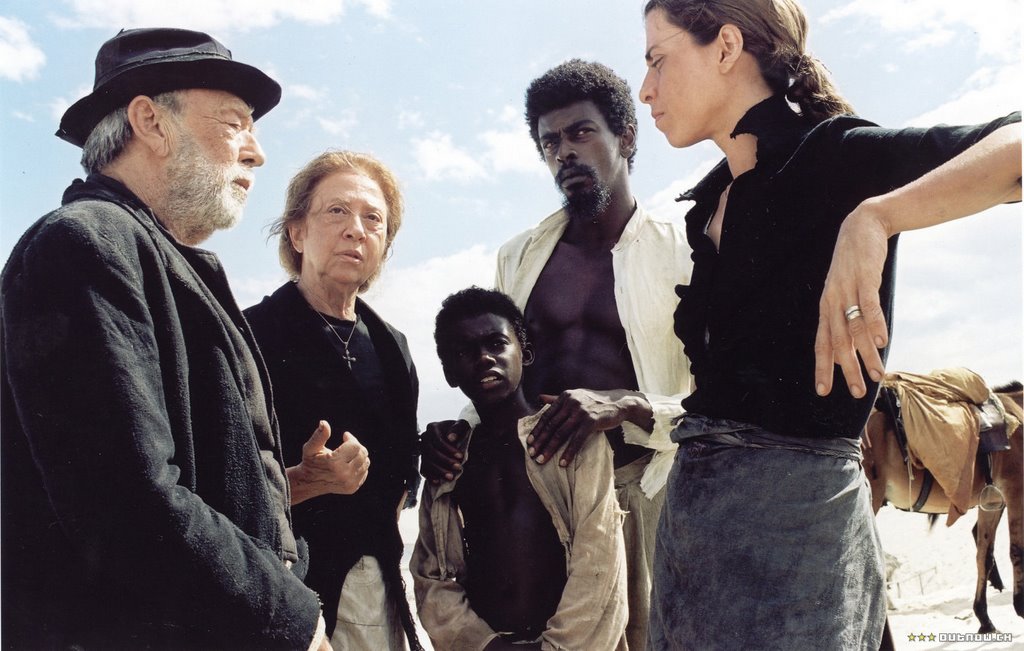
This is the point where The House of Sand fails to lift itself up from merely being an economical film. The film, which deals with a mother-and-daughter relationship spans over more than four decades, is set entirely in a desert, sparing us a swooning cinematography, only to already feel exhausted by the first half of the film.

Yet, the film’s biggest problem lies on the choice of Andrucha Waddington, the director, to cast both leads to play different roles. Arguably, both Fernanda Torres and Fernanda Montenegro are among Brazilian’s finest thespians. However, the risky decision to cast both actresses to play both mothers and daughters within different periods of time prove to be a risk not worth taking at all, for we are hardly convinced with their performance. It is not an easy task to carry different characters within confinement of 2-hour duration, and as a result, we simply do not buy otherwise a great idea. For the actors themselves, what could be a challenging role some actors dream of, simply does not work under a half-baked direction.

Thus, this is the film at its most economical way.

 
Leave a comment

Posted by on 05/27/2006 in English, Film


Heart.

Here are the things you learn from Heart (the movie) that you should apply and consider with your mind, not only relying from your heart (the thing inside your body):

1. a contrived, forced romance should not be made for more than or close to 2-hour long, otherwise any director will run out of tacky lines to utter.
2. running on a tight budget? well, in a matter of film-making, who doesn’t? but sparing the budget for cinematography instead of adding a few necessary cast members is a sin. lucky you, the whole Bandung/Puncak citizen is currently busy tackling their garbage, and not complaining why no one else exists in that area apart from the three main casts.
3. any songs made by melly but not sung by melly should be properly put. where? on the soundtrack album only.
4. if your life is nothing but playing basketball (not even with a team, but just with you yourself and that basketball ring) and painting, here’s my generous advise: get a life!
5. oh, speaking of tacky lines, here’s the thing about teens these days: they are way smarter than that.

Unless we are talking about some hopeless romantics who storm the cinemas, making the film (gasp!) a box-office success. Yes, somehow love-themed stories work best when they despise logic and good quality of filmmaking.

Oh well. I’m out of here.

 
1 Comment

Posted by on 05/26/2006 in English, Film


The Consequences of Love.

Watching a film made from puzzles about one’s life hesitantly scattered pieces by pieces throughout the entire film left one feeling puzzled indeed, in a good way: we get hooked.

The Consequences of Love merely revolves around the life of Titta, an old man with seemingly boring routine. He wakes up, he walks down to a lobby in a hotel where he has been staying in for a number of years. He stays there, reading newspapers until late in the evening when he has to go back to his room to sleep.

Having an almost stationery character like Titta challenges every aspiring filmmaker to bring many additional characters whom Titta will observe, or get involved with. Surely Paolo Sorrentino, the director, follows such a rule, with an underlining bait of his past that soon catches him up. Soon, the past and the present life of Titta will tangle him up, in many ways that thrill our mind, and eyes.

The confinement of space, considering the film is almost entirely set in one location, does not confine Sorrentino from exploring unusual looks which recall any of David Fincher’s works. The carefully captured images in this film is indelible enough to stay on audience’s mind, surely I do, which actually complement the impossibly great twisted screenplay and master-class performance from Tony Servillo as Titta on his commanding presence through stoic manners.

Yet, the film moves, inexplicably.

 
Leave a comment

Posted by on 05/25/2006 in English, Film


The Russian Dolls.

Picking up where The Spanish Apartment leaves us, The Russian Dolls feels fresher, as now the film solely focuses itself on the life of its singular main character, Xavier (Romain Duris in his relaxed performance), particularly in his love department. This means, unlike the predecessor, the film does not have to carry a burden of allocating spaces for multiple characters, which in turn left the first film with a little bit of misled direction.

The focusing does not come with its consequences though, and the one who suffers most from the reduction effect is Audrey Tatou’s character as Xavier’s initial girlfriend, Martine. Halfway throughout the film, the character somehow goes off the film completely, only to be revealed in a lesser scene towards the end, which does not explain or enhance her presence, except to reinstate her annoying charisma built from the beginning.

Photobucket - Video and Image Hosting

Yet, the same cannot be said with Kelly Reilly (that particular shining stripper from Mrs. Henderson Presents) who plays Wendy, Xavier’s English girlfriend. Arguably the only character in the film that breathes full of life, Reilly brings her character in such a charming and likeable manner. Every single turn of her moves, be them as a jealous girlfriend or while hiding her repression of pain, Reilly does them with a believable persona that draws us to her close, rooting for more of her presence.

The rest of returning cast gives a slight brush to the film, which now works as if the audience has graduated from wearing United Colors of Benetton, to a more staple line of Zara. In short, it may not that greatly colorful, but whatever available there are steady ones that will stick to your memory most.

 
1 Comment

Posted by on 05/16/2006 in English, Film


Maskot.

If Maskot feels like a throwback to the good old 70s and early 80s Indonesian comedy, then perhaps Robin Moran, the director, feels the right to do so after watching tremenduous amount of those kind films during the preparation of making his debut film here. Again, it is only a possibility.

Photobucket - Video and Image Hosting

However, the statement above is derived as one can’t help drawing many similarities in this film to the films on the era. At the surface, the basic story premise of Maskot is in many ways applicable as if the film was made by Nja Abbas Acup, Asrul Sani or Chaerul Umam. The film revolves around a search for a hen believed to be the symbol of prosperity for a ketchup company. As the owner of the company (El Manik, in a successive roles required him lying on a hospital bed after his turn in Berbagi Suami) has a declining health, he requests his clumsy son (Ariyo Wahab) to be his successor, but he can only be so if he is able to find that particular hen to be used as a mascot for the factory. Eventually, the search trip has become some sort of coming-of-age journey which resolves in a good way guaranteed to satisfy everyone.

After all, it’s a comedy, right? And good Indonesian comedies of both abovementioned decades, think of Inem Pelayan Sexy, Bintang Kejora and the likes of them, relies on the comic presence of the cast. We are not talking about Bing Slamet, Benyamin S. or Ateng-Iskak films here, where the mere presence of these comic figures would evoke your laughter. Referring to the two aforementioned film, for sure Jalal was on the former film, but hardly any comedy actors present in the latter film, which were filled by character actors such as El Manik, Ikranegara and Amak Baldjun.
Following the similar steps, Moran gave sizable opportunities for the supporting cast of his films to shine. Particularly Butet Kertaradjasa, one of the iconic theatre figures of recent times, and Epi Kusnandar of the TV-series Kejar Kusnadi. Both are able to seize their presence with unique wits and unexpected charm that any scenes without them seem to exhaust themselves.

Thus, in the days of endless mindless teenage romance or horrifying horror, having an Indonesian film that feels Indonesian all around is a refreshing take to indulge.

 
Leave a comment

Posted by on 05/15/2006 in English, Film


the risk of addiction.

so i am addicted to this absence,
which drives me further to making numerous attempts of earning a penny or two maybe,
and not penning my own journal for free.

so i am addicted to the nights,
the companion of flesh and snack,
of two gay guys, one fag hag, and one helluva drinker,
of green teas, or normal ones in alternate.

so i am addicted to the city,
the coffee meets the riots,
leaving me stuck in the unlikely space,
of yuppies, of tough guards, of breezing condensed air.

so i am addicted to you,
the lover of my life,
the hairy bear of my life,
the shivering thoughts sending the hair at the back of my neck rising.

so i am addicted to this life,
of uncertainty, of impossible dream,
of unclear destination, of mindless people and their hopeless defense,
of ambiguity, and the likes of it.

so i am addicted to myself,
living the life i yet to lead.

 
2 Comments

Posted by on 05/03/2006 in English, Personal


where do i leave my heart?

for the past two weeks, i went back living the life i have been very familiar with. being in a comfort zone could not be more exhilarating than this, where people know you for who you really are, and you are free to roam around the city without worrying about what cannot be done to fill your time.

the friends remain the same, their dreams remain afar.

the temptation to go back is always there to lure you, and it cannot be any greater than this time around. after all, what’s not to like about your own comfort zone?

actually, that’s the key of treating this comfort zone. you hate it.

you loathe it by cursing it with the most comprehensive list of cursive words you can ever think of. you despise it by resisting that living in this zone would only drag you down. you hate it to death.

and by doing so, you keep on living nicely and comfortably till you love it.
and that’s the point where you realize you cannot live in any other places.

and you keep on complaining.

and i wish to quit that.

i just wish to live where i can be living.

sadly, it’s not here.

————

who are you? i am a writer.
what do you do? i write.
how do you live? i live.

 
3 Comments

Posted by on 04/17/2006 in English, Personal


one of the highlights

Your Birthdate: April 11

Spiritual and thoughtful, you tend to take a step back from the world.
You’re very sensitive to what’s going on around you, yet you remain calm.
Although you are brilliant, it may take you a while to find your niche.
Your creativity is supreme, but it sometimes makes it hard for you to get things done.

Your strength: Your inner peace

Your weakness: You get stuck in the clouds

Your power color: Emerald

Your power symbol: Leaf

Your power month: November

 
1 Comment

Posted by on 04/11/2006 in English, Personal