RSS

Category Archives: English

/film review/ Banyu Biru – A Tiresome Floating Journey that Seems Never Ending

One, that includes me, can’t help making this kind of classification unfairly given to Indonesian films in general, that is, the film either belongs to commercial market, or whether they are made (and marketed) as an art-y film, which usually associated with being screened on film festivals, locally and globally. Such treatment may not come from the opinionated-public itself, to some extent it is derived from the films themselves, which later on will prove to be some kind of major hindrance in analyzing and understanding the films, in complete.

Watching Banyu Biru is simply unable to escape the notion above.

Just like looking at its misleading poster that suggests a lightweight comedy with the use of plainly bright blue color and showing Tora Sudiro with a supposedly thoughtful, confused look around his face while holding a floating boat that turns to be merely bland innocent look, and the useless effort of maximizing general public interest by putting the name Dian Sastro right below Tora’s, the film seems to be ready to enter the market of commercial films intended to generate greater audience’s interest to flock on cinemas and making some philosophical film a hit.
Yet, the premise, metaphorically associated to the boat in the poster, only manages to float on the surface, drifting along seamlessly and leaving me wondering, what’s the film is all about?

The journey we are about to embark on watching this film refers to Banyu’s journey (Tora Sudiro) in finding his intended direction on life. Having separated from his estranged father (Slamet Rahardjo) ever since he was in high school after going through painful bringing up, now Banyu, being a lonesome depressed man of a big city pinched down to survive, determines to find out the missing link in his life that he thinks leads him to his current state of being. Along the way, he encounters different characters who help shaping his way of thinking, which eventually would lead to his relief. Or is it?

Image hosted by Photobucket.com

The story of how one finds the truth about his own life may be told for numerous times, yet Teddy Soeriaatmaja, the director, failed to bring out a fresh look of this overused theme. It started strongly though, with the sequence of a couple dancing along the song ‘Juwita Malam’, which later would be played throughout the film in many different versions, and a young boy peeks at the couple who turns out to be his parents as the story progresses. The sweet scene done in soft-tone color evokes our sense of nostalgia, and as if Teddy would not want to let the sweetness go away, he seems to be trapped in gorgeous cinematography rather than concentrating on the pillar of a narrative fiction film: good storytelling. Quite a number of beautiful shots taken from unusual angles of point of view are drained to replace the exhaustiveness from the lack of coherent storytelling.
A good defense of these imagery showcases would be to make the film as surrealist as it can be. Some scenes heavily suggest this intention, the strongest would be the dancing scene in the middle of a boring meeting at Banyu’s workplace. Like a rip-off from Bjork’s music video “It’s Oh So Quiet” when all the actors suddenly breakout into dancing moves with no particular expression on their faces, the scene marks as the most relieving part of the film. Yet, this continuity of dream-like quality in the film has to be butchered when the rest of the following scenes force themselves to be filled with un-communicative words, jump directly at intended meaning instead of regular talks that may bring out the purpose of having those talks better. By then, audience’s freedom to interpret and perceive the film is annoyingly disturbed with these meaningless words.
Which also would leave the actors at their dreadfulness, trying hard to interpret the story in unconvincing ways. By any means, Teddy is the most enviable director at the moment for his ability in assembling talented cast comprises of Slamet Rahardjo, Dian Sastro, Didi Petet, HIM Damsyik, Didi Petet, Rima Melati, but surely he would be the unfortunate one who is unable to capitalize their talents. In fact, the surprise of this film is derived from one scene-stealer whose skillful acting presence lingers on my mind long after the film ends: Oscar Lawalata.


You may accuse him of merely playing as himself for the character, coincidental or not, resembles to Oscar’s own character, I believe. However, as the film clearly states at the end-credit that the whole film is fictional and no matter what the background of the actor is, Oscar does the best of all the rest of the actors here. Playing as Arif, a neglected childhood friend of Banyu, Oscar is often put under the silhouette, hiding most of his recognizable signatural feature. Yet, as good as any caliber actors can be in marking his presence without even showing, Oscar does the same through his carefully enunciated words that he delivers with superb, contented delivery, leaving Tora scratching his head for he needs to learn from this scene-stealer.

But as Oscar only does scene-stealing, moreover only one scene which surely is not enough to help the film from going downhill afterwards, what might be able to redeem is the breathtaking beauty of the film’s setting and melodious score that will surely be granted at least a nomination for this year’s Indonesian Film Festival. Too early to predict, but at least the film is saved by these two elements that surely captivated one of the reporters sitting next to me in watching the film who, after the end-credit finishes, immediately blurted out the words to the film’s publicist:
“Pemandangan alamnya bagus ya, mbak!”

I can imagine Teddy smirking.

Final Verdict: Banyu Biru works like a floating surrealism that only drifts around the surface without attempting to go deeper into the core of the story. It escapes the pretentiousness, thanks to commercially-bankable actors who play the roles of the characters here.

Grade: C+

 
Leave a comment

Posted by on 03/10/2005 in English, Film


On Faithful Characters.

I find myself often drawn to liking the kind of characters shown, or rather, performed by the f0llowing list of actors in the following films:

Julianne Moore in Far From Heaven.

Alfred Molina in Frida.

Jessica Lange in Big Fish.

Winona Ryder in The Age of Innocence.

Kerry Washington in Ray.

Tommy Lee Jones in Coal Miner’s Daughter.

Sophie Okonedo in Hotel Rwanda.

Laura Linney in Kinsey.

Donald Sutherland in Ordinary People.

Jennifer Connelly in A Beautiful Mind.

The list may just go on and on, but at this point of time, provided that you are familiar with those entries, you can draw one parallel line of similarity on those entries: they all portray faithful spouses, who devote their lives wholeheartedly to their partners. Considering that most of them are taken from the real life stories, the look couldn’t get any more interesting.

Why interesting?

Despite the spotlight often falls on the glamorous, larger-than-life characters often portrayed on the big screens, there are always sidekicks or supporting roles who in occurences beyond rarity, steal and even hijack the scenes and the films they are in. With the exception of Moore‘s placement as a leading role (not to mention that the film itself focuses on this supposedly secondary role), the other roles are put as supporting ones, God knows if it’s unknowingly or intentionally.
Certainly they fit to what Tammy Wynette sings in her infamous song “Stand By Your Man” which I shall not probe into this deeper as you may already guess from the title itself.
These characters have become something great on their own for their magical ability in supressing their ego-centrism of themselves to serve their partners dutifully, they are aware of their own choices to be put under or behind the shadows of the men or women they adore and admire. For that, it comes with a price.

Molina has to bear Hayek‘s lust over different kind of life, as to what Moore does to Quaid.
Washington chooses to stick to Charles despite his odd behaviour, while Ryder does it silently, but carefully observes every thought created within Day-Lewis‘s mind.

However, at the end of the day, the so-called suffering that they themselves may not be able to experience those actions as torture for they have embedded within their characteristical thoughts too deep, will get its own reward. To see how Crowe surrenders over Connelly‘s presence and thanks her at the Nobel Prize ceremony scene is a testament on how generosity and endurances will pay off.

Not that they are lack of their own ability or skills that the world may embrace. After all, Linney‘s character is a bright science student prior embarking on a risky life that lasts a lifetime with Neeson. Yet, the turnaround she chooses prove to be a towering platform that strenghtens and enrich herself and the couple’s life.
Or maybe at that time she thinks that she may not be able to move forward with her academic journey as a scientist, we never know. Life’s about different kinds of possibilities and choices we have to make after all.

And to end this ramblings, I can’t help myself humming along this standards that received a dramatic treatment so achingly beautiful by Barbra Streisand at the end of her career-launch pad The Funny Girl:

“oh my man i love him so / he’ll never know / all my life is just a spare / but i don’t care / when he takes me in his arms / the world is bright / alright / what’s the difference if i say / i’ll go away / when i know i’ll comeback / on my knee someday / so whatever my man is / i am his / forever more …”

Goodness! Even a gay icon would love to sing a song strong with male-chauvinism!

 
Leave a comment

Posted by on 03/09/2005 in English


77th Academy Awards – Post-Show Reaction

This year’s Oscar, contrary to everyone’s complaining about its boredom, proved to be like the suspense of its Best Picture winner. It started at a moderately slow pace with a cloud of worries hanging above my mind whether this time Academy Awards would make another disappointing blow by rewarding a big-bang epic as the flick started strongly in collecting the prizes. Yet, as the time gradually progressed, fists and clinches were punched, a little defense here and there, disappointment and mild surprises arose, and the ending was relieving.

The Oscars at this year’s 77th Academy Awards went to:

Best Costume Design: The AviatorSandy Powell
(I thought that her win in Shakespeare in Love last time would prevent her to champ again this time, but, being a respectable costume designer on her own whose work I often admire, she deserved the award. However, Edna Mode stole the show!)

Best Make-up: Lemony Snicket’s A Series of Unfortunate EventsValli O’Reilly, Bill Corso
(got it right this time, and nice acceptance speech! “Lemony Snicket’s corrupting our youth”?!)

Best Animated Feature: The Incredibles
(Brad Bird went very polite)

Best Supporting Actor: Morgan FreemanMillion Dollar Baby
(was it technical glitch that the camera kept showing Clive Owen’s face when the winner was about to be announced? the first sentimental award of the nite)

Best Art Direction: The AviatorDante Ferretti, Francesca LoSchiavo
(as expected, began to suspect strong Italian-connection in every Scorsese’s film)

Best Supporting Actress: Cate BlanchettThe Aviator
(finally! her acceptance speech was plainly ‘standard’, yet it ended with a punch: “Thank you Scorsese, I hope my son will marry your daughter”! nice ad-lib!)

Best Documentary: Born Into Brothels
(worth of applause)

Best Editing: The AviatorThelma Schoonmaker
(and Scorsese shed a tear)

Best Adapted Screenplay: SidewaysAlexander Payne & Jim Taylor
(they deserve this award than any other nominees, and Payne has all the potential to be a good light-comic actor himself)

Best Visual Effects: Spider-Man 2John Dykstra, Scott Stokdyk, Anthony LaMolinara, John Frazier
(“thank God no Lord of the Rings this year”?! another nice punch!)

Best Short Film, Live Action: Wasp
(missed)

Best Short Film, Animated: Ryan
(huh?)

Best Cinematography: The AviatorRobert Richardson
(I began to worry if the film would walk away with the Best Picture award!)

Best Sound: RayGreg Orloff, Bob Beemer, Steve Cantamessa, Scott Millan
(thank God for the surprise!)

Best Sound Editing: The IncrediblesMichael Silvers, Randy Thom
(the ‘toon flick deserved more than just one award, and it got the right one)

Best Documentary Short: Mighty Times — The Children’s March
(I was just plain lucky)

Best Original Score: Finding NeverlandJan A.P. Kaczmarek
(I may have a strong personal relation to the film and the score itself, but such a fleeting, breathtaking beauty of melody and harmony would surely have to be rewarded after all)

Best Original Song: The Motorcyle Diaries – “Al Otro Lado Del Rio” by Jorge Drexler
(surely he was pissed off for not given a chance to perfrom the song himself, and Banderas did not do the job well, yet Drexler got the revenge and he pulled it off just nicely!)

Best Leading Actress: Hilary SwankMillion Dollar Baby
(Staunton looked calm and still, Moreno was just happy to be nominated, Winslet smiled widely as usual, Bening remained seated, and me? brokenhearted.)

Best Foreign Language Film: The Sea Inside (Spain)
(Alejandro Almenabar! Alejandro Almenabar! finally getting the recognition for his consistenly good works!)

Best Original Screenplay: Eternal Sunshine of the Spotless Mind Charlie Kaufman, Michel Gondry, Pierre Bismuth
(he was robbed for Being John Malkovich and Adaptation., Kaufman richly deserved to be applauded with standing ovation!)

Best Leading Actor: Jamie FoxxRay
(everyone’s lock)

Best Director: Clint EastwoodMillion Dollar Baby
(what can I say, Marty?)

and finally,

Best Picture: Million Dollar Baby
(just exactly when Babs said, “I’m so happy to give it to you again, Clint”, I screamed hysterically out loud in joy, for finally Oscar got it right this time, for finally Oscar played its suspense element very well until the very end of the whole show!)

There it was, the Oscar ceremony which I never thought Johnny Depp and Sean Penn would attend, which I might have to ban Beyonce for showing-off way too much, which I felt glad for Million Dollar Baby.

Special credit would go to Yo-Yo Ma, the show stealer who gave a hearty, touching performance that would be forever noted as the best ‘In Memoriam’ piece Academy Award has ever made.

So long!

 
Leave a comment

Posted by on 02/28/2005 in English, Film


77th Academy Awards – I Have A Say!

(A little unimportant note serving as ‘epilogue’ of this writing is simply the fact that actually I did make a draft of what’s supposedly to be my final prediction, yet, being too ecstatic of the upcoming day-off on Monday excited me way too much to the effect that I did f-o-r-g-e-t to bring that file home! Well, I managed to compose an email from my work’s email ID that was meant to contain an attachment of this file, yet, again, I did f-o-r-g-e-t to attach the file. Hooray! Here I am, stranded on my yellow chair, trying to get myself brainwashed with Norah Jones’s songs prior to her concert in two days, and recalling what I wrote throughout this afternoon. Oh for goodness sake! Just let the red carpet roll on and here we are …)

The time of the year of has come again.

The time of indulging in one’s triumph and another’s loss.

The time when work of merits is questioned and often set-aside by sympathy, empathy, and popularity.
After all, how can one explain Grace Kelly’s winning over Judy Garland? Or the fact that Bette Davis did not clinch the award for her Margot Channing’s turn in All About Eve? And how can Nicole Kidman be in Best Actress in a Leading Role while she shared the equal screen time and character’s connection to the story as the other two actresses?

Welcome to the Academy Awards, an annual event of glitz, glamour, dirty, tricky campaigns, where everything merges into one popularity contest.
Not that being popular means being un-worthy, after all, Al Pacino’s convincing portrayal as a blind veteran deserve to win, but Paul Newman’s repetition of character in The Color of Money?
So much that it takes to recognize sentimentality that is covered under the word of ‘overdue’. Apparently, this year’s race is all about overdue recognition for thespians who, with or without Oscar, we will always recognize their talents and invaluable contribution to the cinematic history.

Take a look.


BEST PICTURE:
The Aviator
Finding Neverland
Million Dollar Baby
Ray
Sideways

Nauval says:
In the tradition of big-scale epic Hollywood used to reel on, The Aviator has everything: a dashing leading man, a woman or two on his side, terrifying action scenes, manipulative villains, yet it also includes complicated and misconstrue story that, well, leave the plane stuck to the ground. The meticulous technical aspect may make-up for those losses, yet if the film gets chosen to grab the coveted prize, it’d only label Academy Awards to be pretentious, rewarding a film that seems grand on the surface yet leaving many loopholes inside.

On the other hand, Million Dollar Baby, that seemed to smoothly slip under the radar throughout the entire pre-awards season, soars high on its simplicity, low-key theme of simple ambitions radically turning to an unexpected change. Slowly the film builds up and grabs our attention, leaves us thinking of the emotional impact Clint Eastwood cleverly inserts throughout. Yet, the controversy over its ending may slightly disrupt the momentum the film has gained so far.


Which is not the case for Finding Neverland and Ray, two nominees that relatively play on the ‘comfort zone’. Neverland has an abundance of charm and sweetness that seem to be an oasis on the desert of cynicism in real life, or adulthood to be precise if related to the object of this film. Ray itself is made to be a major tribute to the legendary Ray Charles, and it manages to avoid clichés being one of numerous made-for-TV biopics, thanks to the cutting edge style chosen by Taylor Hackford to deliver the story.


Yet, I can’t stop thinking of this ad I stumbled on Variety magazine that stated: “Rarely does a good comedy come along that needs to be taken seriously” (more or less so). Obviously, the advertisement refers to Sideways on its campaign to be recognized more widely by voters. You may think that being already showered with many critical notions is more than enough? So many theories or hypothesis to answer the question, yet we can say that comedy is often under-appreciated when it comes to Oscars, as voters prefer to reward high-minded brows, or worse, brainless epic.

Why do I root for Sideways here? Because to reward a deeply moving and contented film like Sideways, is to reward the life itself.

Will win:
Million Dollar Baby

Should win:
Sideways

Should have been nominated:
Eternal Sunshine of the Spotless Mind, The Incredibles, Kinsey, Closer, Dogville


BEST DIRECTOR:
Clint Eastwood (Million Dollar Baby)
Taylor Hackford (Ray)
Mike Leigh (Vera Drake)
Alexander Payne (Sideways)
Martin Scorsese (The Aviator)

Nauval says:
One of the regrets from BIFF ’05 is to miss Vera Drake, and that causes my inability in commenting about the film and its 3 nominations here. However, should Mike Leigh maintain his skillful direction he showed in his previous works like Secrets & Lies or All or Nothing, then he would stand a chance to make an upset here. After all, one slot for non-Best Picture nominee’s director here would always be reserved for outstanding direction that at times even eclipse the work of this winner’s category.
And by saying that, I am intending to question the motivation of Academy shall they choose to give the award to Scorsese. If he wins, surely sentimentality plays a major role here, although it is hard to justify one’s career-long achievement by rewarding his least personal film.

On the other hand, the same case does not apply to Eastwood. His maturity in understanding human characters goes even deeper in Million, and the way he presents the somber film in intriguing direction strengthens his triumphant in excellent filmmaking, after all, boxing may not be his cup of tea, yet he made the film as the meatiest one he ever made.

Whereas Hackford and Payne have done some commendable job in delivering cutting-edge films that do freshen up the competition, they will have to remain as long-shots here.

Will win:
Martin Scorsese

Should win:
Clint Eastwood

Should have been nominated:
Michel Gondry (Eternal Sunshine of the Spotless Mind), Michael Mann (Collateral), Zhang Yimou (Hero/House of Flying Daggers), Quentin Tarantino (Kill Bill Vol. 2), Mel Gibson (Passion of the Christ)

BEST ACTOR IN A LEADING ROLE:
Don Cheadle (Hotel Rwanda)
Johnny Depp (Finding Neverland)
Leonardo DiCaprio (The Aviator)
Clint Eastwood (Million Dollar Baby)
Jamie Foxx (Ray)

Nauval says:
I may overtly-praise Eastwood’s being listed in Best Director nomination, but seriously, what does he do here? His place here has shamefully taken the lives of many other deserving nominee, particularly Paul Giamatti in his sensitive portrayal as a middle-aged man in Sideways who might put the stiffest threat in this category.
Yet, even Giamatti’s submission would not even be able to encounter or to hijack the magical presence of one man that will go down as one of the few names in the history of Oscar to really deserve the award:

Jamie Foxx.

His uncanny resemblance to Ray Charles in this film not merely caused by the makeup, but more than that, Foxx has imbued and injected his own believability in playing the role, enriching the already-rich persona to the extent that we do see Ray himself on the screen.
With such an over-the-top performance, he will face no difficulty in walking away with the coveted prize. A possible upset may come from Cheadle who surprisingly gives a three-dimensional performance in Hotel Rwanda. His accent is impeccable, his gesture shows that it comes from the instinct instead of merely acting, and being hidden under the shadows of more famous stars all this time would surely boost his chance to be more recognized.

I am quite disappointed with DiCaprio’s blocked-performance resulted from being and trying too hard to look serious in the film. On the other hand, Depp’s understated performance seems to be next-to-nothing whenever he appears with Kate Winslet on the film, Finding Neverland.

Will win:
Jamie Foxx

Should win:
Jamie Foxx

Should have been nominated:
Paul Giamatti (Sideways) – I do not mind if he wins!, Gael Garcia Bernal (Bad Education), Liam Neeson (Kinsey), Javier Bardem (The Sea Inside), Jim Carrey (Eternal Sunshine of the Spotless Mind)

BEST ACTRESS:
Annette Bening (Being Julia)
Catalina Sandino Moreno (Maria Full Of Grace)
Imelda Staunton (Vera Drake)
Hilary Swank (Million Dollar Baby)
Kate Winslet (Eternal Sunshine of the Spotless Mind)

Nauval says:
Again, one nomination from Vera Drake.
And this time it even heightens my curiosity as Staunton did a remarkable sweep in earlier pre-awards season, although later on her name seems to be drowned by the more popular ones. However, given the fact that Staunton plays such a demanding role would help her getting an edge on this category.

Yet, the same edge would not be applicable to Moreno and Winslet, although their names submitted here do give the category a refresh look and credibility to Academy to be brave in rewarding off-beat performances, breaking out tradition of women playing ‘typical’ safe roles.

And what are those ‘typical’ roles, you may ask?

Either you hate or love it, but Academy loves to see women de-glamorizing themselves to play woman at her utmost un-appealing look of dreadfulness, sorrow and grievances. Halle Berry in Monster’s Ball, Nicole Kidman in The Hours, Charlize Theron in Monster, they have shown what it takes to win in this category. What a male-chauvinist pig Academy has been!
One name that suits the criteria is, obviously, Hilary Swank in her role as down-to-luck waitress-cum-boxer in Million Dollar Baby, and interestingly, she did the same de-glam effect to more extreme extent when she won five years ago in Boys Don’t Cry. Swank does add the meat to the heavily-weighted somberness in Million, and no matter how I plea for Academy to spread its wealth to the rest of the nominees, I can’t help seeing that Swank’s performance indeed deserves to be rewarded.

However, wouldn’t it be nicer if Bening wins? Surely she’s been overdue, she may not be able to capture the same chance again considering her advanced age, but beyond that, the role she plays as an aging, demanding diva Julia Lambert is a reminiscence of Hollywood’s golden days when women were often portrayed as a quick-wit, manipulative and pure human being in control of her surroundings. In other words, Bening’s winning in this category would be a nice tribute and gesture of apology from Academy to other diva-roles that never got rewarded in the past: Gloria Swanson in Sunset Boulevard, Bette Davis in All About Eve, Judy Garland in A Star is Born …

Will win:
Hilary Swank

Should win:
Annette Bening

Should have been nominated:
Julie Delpy (Before Sunset), Uma Thurman (Kill Bill Vol. 2), Nicole Kidman (Dogville), Kate Winslet (Finding Neverland)

BEST ACTOR IN A SUPPORTING ROLE:
Alan Alda (The Aviator)
Thomas Haden Church (Sideways)
Jamie Foxx (Collateral)
Morgan Freeman (Million Dollar Baby)
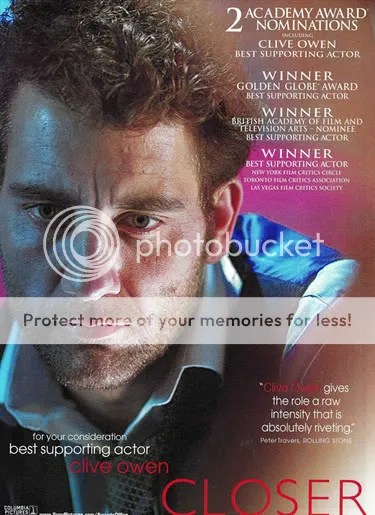
Clive Owen (Closer)

Nauval says:
It’s all about sentimentalism here!
The sudden hype on Alda’s performance derives from the fact that he was often neglected in the past, and the submission of Foxx’s name here rides high from his buzz on Ray.

Certainly the favor is in Freeman, being passed for three times and now in his fourth nomination, he was acknowledged by his peers in Screen Actors Guild recently, and considering the major role SAG has in determining acting-branch winner, Freeman stands a good chance here, although personally I don’t think his role here is as bravura as his turn in Driving Miss Daisy or The Shawshank Redemption.

For Church to play well is simply to play himself. No one has understood Jack’s character as a washed-out soap opera star better than Church, a has-been actor himself who used to be regulars on “Wings” and “Ned and Stacey”. However, being the only actor with a comical role in this category would surely enhance and strengthen his position here.

Yet, if I’d be able to vote, my pick falls on Owen’s grand presence in Closer. Seamlessly shifting and drifting between being charismatic and menacing at times, some people may find his character’s cold-heartedness as purely antagonistic character, yet Owen injects his own charm that makes even an antagonist can be perfectly emphatized by the most sinister of critics and audience.

Will win:
Morgan Freeman

Should win:
Clive Owen

Should have been nominated:
David Carradine (Kill Bill Vol. 2), Peter Sarsgaard (Kinsey), Freddie Highmore (Finding Neverland), Rodrigo De la Serna (The Motorcyle Diaries), Paul Bettany (Dogville)
BEST ACTRESS IN A SUPPORTING ROLE:
Cate Blanchett (The Aviator)
Laura Linney (Kinsey)
Virginia Madsen (Sideways)
Sophie Okonedo (Hotel Rwanda)
Natalie Portman (Closer)

Nauval says:
Personally, this is my favorite category of all in this year’s race, as all of them deserve to be nominated, and to this date, it’s still pretty much open race to all of them.

Linney dominates the screen time in Kinsey and her remarkable journey from young Mrs. Kinsey to the older one is a true testament of her in-depth understanding in carrying the role vividly, towering herself above her male companions.

Okonedo defines the term ‘supporting’ itself, her presence there boosts Cheadle’s performance and by choosing not to steal the spotlight from him, we get drawn to whenever Okonedo appears on the screen.

Portman gives a surprisingly good performance in her first adult role, slips into her role convincingly, complete with her fragility and innocence look that makes her character notable even more.

Madsen, the critics’ darling, while given the least screen time compared to anyone else here, captured every single second and frame of her performance, even when she is only heard, we are taken to believe that she indeed is an inseparable part of Sideways’ deepest core of the story.

However, only one award is given out, and this time, let it be Blanchett’s.

Shamelessly I say that she’s the best actress around who consistently giving out her best no matter what kind of films she’s starring in (remember Pushing Tin? The Gift?), and no matter you may call me being sentimental, but she deserves to be rewarded, for already being unfairly passed in Elizabeth, should have got nominated for Bandits and Talented Mr. Ripley, and now, with her majestic performance in The Aviator playing the screen goddess of all time, Katharine Hepburn, this is Blanchett’s glorious night.
Blanchett’s take as Hepburn is terrifyingly real despite not covering herself with prosthetic make-up, more than that, Blanchett digs the inner persona of Hepburn to create a dignified presence of Hepburn like we’ve never seen before. Refreshing and believable, Blanchett’s majestic performance is the only thing that kept me glued to the seat throughout the entire duration of the film.

Will win:
Cate Blanchett

Should win:
Cate Blanchett

(but really, whoever wins in this category, I’m just plainly happy! J)

Should have been nominated:
Meryl Streep (The Manchurian Candidate), Sharon Warren (Ray), Regina King/Kerry Washington (Ray), Irma P. Hall (The Ladykillers), Isabella Rossellini (The Saddest Music in the World)

BEST ADAPTED SCREENPLAY:
– Richard Linklater, Kim Krizan, Ethan Hawke & Julie Delpy (Before Sunset)
– David Magee (Finding Neverland)
– Paul Haggis (Million Dollar Baby)
– Jose Rivera (The Motorcycle Diaries)
– Alexander Payne & Jim Taylor (Sideways)

Nauval says:
How I wish Before Sunset to win!
One of the best sequels ever made, one of the purest love stories ever created, Sunset defines romance and love in such an unbelievably intelligent manner that leaves us feeling longing for similar chemistry to happen in this ordinary life.
Yet, the moment certainly belongs to Alexander Payne & Jim Taylor here. This is the only category where they can be confident, highly confident as a matter of fact, to grab the award. They more than deserve it.

Will win:
Alexander Payne & Jim Taylor (Sideways)

Should win:
Alexander Payne & Jim Taylor (Sideways) / Richard Linklater, Kim Krizan, Ethan Hawke & Julie Delpy (Before Sunset)

BEST ORIGINAL SCREENPLAY:
– John Logan (The Aviator)
– Charlie Kaufman, Michel Gondry & Pierre Bismuth (Eternal Sunshine of the Spotless Mind)
– Keir Pierson & Terry George (Hotel Rwanda)
– Brad Bird (The Incredibles)
– Mike Leigh (Vera Drake)

Nauval says:
Alritey, enough about the hype on The Aviator, apparently the script has undergone some butchering process and what you see on the screen, well, I shall not prompt further.
This category has Charlie Kaufman words all over the place, and still faithful to his eccentric, original style of writing, Eternal Sunshine proves to be the most appealing of his works, at least to Academy members who might not comprehend the depth of Being John Malkovich and Adaptation..
Possible upset may come from Mike Leigh, or … Brad Bird? If it is so, what a jolly good surprise then!

Will win:
Charlie Kaufman, Michel Gondry & Pierre Bismuth (Eternal Sunshine of the Spotless Mind)

Should win:
Charlie Kaufman, Michel Gondry & Pierre Bismuth (Eternal Sunshine of the Spotless Mind)

BEST ANIMATED FEATURE:
The Incredibles
Shark Tale
Shrek 2

Nauval says:
Need we debate over this?
But seriously, Shark Tale instead of The Polar Express?

Will win:
The Incredibles

Should win:
The Incredibles

BEST FOREIGN LANGUAGE FILM:
The Sea Inside (Spain)
The Chorus (France)
Yesterday (South Africa)
Downfall (Germany)
As It is in Heaven (Sweden)

Nauval says:
Only saw two out of five here, The Sea Inside and The Chorus, the former does uplift audience’s spirit and the latter falls into cliché of tearjerker film. Alejandro Almenabar and Javier Bardem will walk up to the stage collecting the award.

Will win:
The Sea Inside

Should win:
The Sea Inside

Should have been nominated (so many good films being passed over!):
Maria Full of Grace, Bad Education, The Motorcycle Diaries, A Very Long Engagement, House of Flying Daggers, Facing Window, I Not Scared.

+ + + + + + + + + + + + + + + + + + + + + +

There you go, the ten nominations that I give my comments on. The rest of my prediction will come below:

BEST DOCUMENTARY FEATURE:
Super Size Me
(what a slap if it really happens!)

BEST ORIGINAL SCORE:
Finding NeverlandJan A.P. Kaczmarek
(seriously, don’t you get tired folks in listening to formulaic scores of John Williams? And what does James Newton Howard do in the almost-silent The Village?)

BEST ORIGINAL SONG:
“Look To Your Path (Vois Sur Ton Chemin)” – The Choir (France) – Bruno Coulais, Christophe Barratier
(where’s Mike Jagger and Dave Stewart whenever they’re needed? And “Believe” from Phantom of the Opera does not sound anywhere near being opera-ic)

BEST CINEMATOGRAPHY:
A Very Long EngagementBruno Delbonnel
(visually captivating, Jean Pierre Jeunet’s rich direction needs to be rewarded in one way or another)

BEST COSTUME DESIGN:
Lemony Snicket’s Series of Unfortunate EventsColleen Atwood
(fantasy film shall prevail)

BEST ART DIRECTION:
The Aviator Francesca Lo Schiavo (Art) & Dante Ferretti (set)
(love Ferretti’s works ever since The Age of Innocence, although it is still possible that Lemony’s team may hijack this category)

BEST MAKEUP:
Lemony Snicket’s Series of Unfortunate EventsValli O’Reilly & Bill Corso
(putting on make-up for multi-faces of Jim Carrey in multiple characters is surely a hard work to do)

BEST SOUND MIXING:
The AviatorTom Fleischman & Petur Hliddal
(the airplane-crash scenes do justify this)

BEST FILM EDITING:
The AviatorThelma Schoonmaker
(although Collateral’s winning would be welcome as well)

BEST SOUND EDITING:
Spider-Man 2Paul N.J. Ottosson
(otherwise those fighting scenes would not be believable)

BEST VISUAL EFFECTS:
Spider-Man 2John Dykstra, Scott Stokdyk, Anthony LaMolinara, John Frazier
(otherwise the comic elements would not come up well)

Final note:
Set aside the sentimental feeling, the sentiments over the overdue-s, this is Oscar! Have a blast, people!


Leave a comment

Posted by on 02/26/2005 in English, Film


/film review/ Sideways.

Being the last on the list of that top five pictures I’ve got to see, there was this overtly ridiculous anxiety on how this film that I was about to indulge myself into is gonna be. Not to help soothing and calming down my jolt was the constant reminder from fellow film enthusiasts like Rio or Ve who kept bugging me to watch this film for the sake of their forecast on one eagerly-awaited event on Monday.
So there I was, not being late as usual, nicely sat on a side-seat near the passage way to drive myself over SIDEWAYS.

Little did I know that the road trip I was about to ride on is going to be the most thrilling film-watching experiences one has ever taken in his life.

Sideways focuses its story on a wine-tasting trip taken by Miles, an aspiring writer and a struggling English teacher who decides to throw this trip a week prior to his buddy’s wedding, Jack, a has-been soap opera actor forced to do commercial voice-over work. Not merely being a wine-tasting, scenery-viewing road trip, it has emerged into a journey of their lifetime with several encounters that would change their perspective on lives, particularly from the presence of Maya and Stephanie, two women differ in a great stark of contrast from one another, who both contribute possible changes of turn in their seemingly-destined bleak future. Of course, the choice lies on both men’s hands then to opt for the change, or heading straight to the planned ones.

Now you must be tickled: where’s the humor, pal?

Now I can only ask back: do we need to intentionally create one? For the fabricated ones would only evoke silliness?

Surely one or two slapstick scenes are made to enlighten this already-enjoyable film, but the rest of the comedy part is scattered evenly throughout the entire 120-minute, balanced nicely with some touching scenes that, well, seem ordinary to some extent. Just like our lives itself, there are times we may be laughing over-the-top over other people’s misfortunate and within seconds we can turn in bedazzlement to sympathize with it, and times when we feel completely being nothing next to other people’s well-headed lives.

Just like me, and mostly, everybody else.

Therefore I salute Alexander Payne and Jim Taylor for consistently uplifting our egoistical mood through their off-beat works that strike our chord to appreciate and embrace the life. From the hilarious Citizen Ruth to Reese Witherspoon’s innocent ambitions of taking part in a high school’s Election to divinely somber About Schmidt, here are two filmmakers riding high on the spirit of true story-telling a la 70’s films. Naivety is the forbidden word never to be applied here, just plainly real and never be deceiving or degrading or even insulting.

Even more, those stated effect is successfully achieved through the top-notch class acts from this group of underdog actors who, like it or not, always get overlooked and under appreciated. After all, in the world of Botox-perfected faces, who would’ve thought that Paul Giamatti could fit into description of the leading man who can carry a film on his shoulder? Or the already-a-has-been Thomas Haden Church who seems to be playing himself in the character Jack, so much so that the act itself gives me a jittery feeling? Or Virginia Madsen, best remembered for her forgettable turn in Candyman? Or Sandra Oh, always-second-rated actress who almost hijacks Under the Tuscan Sun completely from Diane Lane?
Together this foursome created chemistry unlike any other buddy-themed films ever made or even attempted to. Led by Giamatti as Miles, the model, picture perfect of depressive man heading towards directionless ambition who has to surrender to the cruelty of life, who simply yearn to be recognized for his talent, yet never dares himself to plunge and take the risk, which may lead to success. Every single smirk, smile, change of expression shown in Giamatti’s face that often got close-up in this film will reveal the truest character of this role.

If what you read all above will mostly strike your chord, worry not. Or even if you still find those words are plain and ordinary, worry not either. For its warmth and tender humor derived from life experience, for its believable performances from superb cast ensemble, for scores and music that never alienate the scenes the music is supposed to accompany with, for the most humane story of any films recently released, for a clear direction that inspires, I present my whole-hearted vote for Best Picture:

SIDEWAYS.

 
Leave a comment

Posted by on 02/25/2005 in English, Film


found!

i find you through a stack of hays

i find you through a bundle of clouds

i find you through interconnected linkages

i find you through myself

i find you through your presence

i find you through your absence

i find you through silence

i find you through confusion

i find you through longing

i find you through thoughtful thoughts

i find you through clickings

i find you through ramblings

i find you through comments

i find you through mishaps

i find you through chances

i find you through abstinence

i find you through …

i always find you.

 
Leave a comment

Posted by on 02/22/2005 in English


/film review/ Ray

Have you ever felt or had a little reservation prior to watching a film that is caused by a certain relation or some kind of degree-of-separation about the film you are about to see?

I had one, and to be exact, I had a little reservation prior to watching Ray, simply for the fact that I was a little disappointed seeing another biopic-musical weeks earlier. That unfortunate film in which its musical spirit was unfairly removed is called The Buddy Holly Story, and had it not been for Gary Busey performance, I would surely have discontinued watching that soulless film. However, my worry has diminished the minute flickering flame appears on the big white screen, forming a sillhouette playing against the opening credits of RAY.

And what a soulful journey it was!

As the title itself suggests, Ray shows us the life of the genius legendary late Ray Charles Orbison from his traumatic childhood where he caught glucome at a mere age of 6 years old that left him blind for the rest of his life, to his rise of stardom that forever changed the modern music scene for the past 50 years. Along the way, we are shown with many interesting characters who have shaped the existence of Ray Charles and his music as what we have enjoyed until now. These characters did play and give major contributions in creating many of Ray’s hits, as well as occurences happened during the creation of those songs, allowing us as the audience to be given a privilege of private access in analyzing how his works like “Mary Ann” was made as he fell for his band’s singer and created the song based on her presence, or “Mess Around” was unintentionally created as he threw a tantrum to Margie, his backup singer, that ended up in a long argument over their decision to stay apart from one another personally.

Such an angle of storytelling allows Hackford to play around with his skillful direction in presenting Ray’s story through manners that the late genius himself would approve had he been alive: painfully glorious.
Ray’s achievement had to bear numerous hardship in his life, not merely on his physical disabilities, but also on his mentality going crippled with his drug addiction and womanizing-behaviour. Yet, through his songs, he spoke out his sentimentality and playful feeling at times, a genius who immersed himself fully in his works, and the way Hackford presented this story in condensed 152-minute duration that leaves us with tears, laugh and longing for more of Ray, clearly shows the masterful understanding of the music and the soul of the legend behind the glory.

Enhanced with a majestic performance from Jamie Foxx in the titular role that is destined to be the role of is lifetime, Ray looks amazingly believable, thanks to his uncanny resemblance that just simply blew my mind. Having been hid or put under shadow for a long time, Foxx finally deserved this rich attention, no matter how overwhelming it can be, for he gives a heartfelt resemblance as the genius himself. Not merely enough to be contented with piano skills, the way Foxx does his gestures as Ray has prompted us to really think that he embodies the utmost complete spirit of Ray.

However, one scene-stealer really caught my attention way long after the film ends: Sharon Warren.

A relatively unknown who shines in her acting debut (really!), she wrecks our hearts in playing the role as Aretha Charles, Ray’s beloved, good-hearted mother who determined to make a good living for Ray. She has this advantage for not necessarily sharing any scenes with other more established actresses like Kerry Washington or Regina King, and she does seize that chance by showcasing her unbelievable emotional acting skills that leaves us wanting for more of her. Seems that not enough screen-time for her in the film. When she weeps and bursts out her grievances, we are prompted to symphatize with her.

Ray Charles Orbison would surely be smiling widely from up above, looking down proudly of this film.
Salute!

 
Leave a comment

Posted by on 02/21/2005 in English, Film


/film review/ Aviator, The

Glossy! Glitzy!

Those are two words that kept popping inside my head upon walking out of the theatre where I watched this tale of Howard Hughes, one of the greatest, or perhaps the most eccentric men who marked his presence in film industry and aviation field like no other tycoons have ever done. As loaded with larger-than-life images and stories, somehow the plane that I boarded in this film never really took off.

In his latest ambitious effort to capture Best Director prize in Academy Awards, Martin Scorsese tried to put his hand in making another biopic this time, in a scope of epic scale that he has recently indulged himself in to, with the likes of Gangs of New York or recalling a decade earlier, The Age of Innocence. THE AVIATOR focuses on the time span of early to mid 20th century, the time when Howard Hughes name would guarantee admirations and smirks at the same note, just as eccentric as his behavior can be, the name itself similar to the word controversy spelt all around his presence. From a movie-mogul to planes-obsessed person, from Katharine Hepburn to Ava Gardner to numerous starlets, Howards Hughes’ story is the story Hollywood filmmakers are dying to have, as rich as films that Hughes himself might direct or produce.

Yet, as any epics that look splendid on the surface, so does the film.

Scorsese painstakingly put an extra effort in recreating certain looks that he wanted to achieve by using different degrees of color associated to the ‘film-look’ of the era in which any particular part of the story took place, gradually emerged into a more natural look towards the end of the film. Such a pleasant viewing for the eyes, and apparently those external elements of tuneful music, exhilarating set designs and costume design did not help elevating this film to a higher level where I don’t need to wander my mind away for almost three-hour duration.

Which would lead us thinking: what is wrong with the story?

As the film itself was meant to be a tribute to celebrate Hughes remarkable achievement in his peak period of time, which is why the timeline would only stretch from mid 1920s to 1950s, the story seems to be drifting apart in between glorifying his fame to retelling his private live which differ in a great contrast from one another. Certainly John Logan had to bear a difficult task in merging these two, not to mention that the script itself has been tossed around for years in development, suspiciously resulting in catharsis of mediating between the two, leaving different stories stand on their own.

The only thing that is able to keep me glued to my seat is the eclectic performance delivered by Cate Blanchett in her perfect-pitched impersonation as Katharine Hepburn. Not merely mimicking her accent or gesture, Blanchett went to the extent that she imbued the Hepburn persona within herself, so much so that while we could still see Blanchett on the screen without any exaggerated prosthetic makeup, we are taken to the state of believability that the soul of Hepburn was present in the film, thanks to Blanchett decision to play her character from within, and Hepburn’s over-the-top gestures were convincingly and vividly portrayed as if Blanchett has forever donned this role to her own character for a long time.

However, the same cannot be said to Leonardo DiCaprio who tries too hard to capture the eccentricity of Hughes by risking himself to certain unnecessary acts, only show to us that DiCaprio himself has not been able to shake off his own image as a dashing young actor in delivering the role. Looking at him in the big screen, one may not help wondering if Hughes did really raise his eyebrows all the time, or how unconvincing it is to see him alongside the grand presence of Blanchett as Hepburn. It does not help either when he bared himself on the screen to show Hughes’s near-madness mental situation, or his smirk face shown when he got obsessed with cleanliness to the extreme. Call it a curse of his handsome feature, yet DiCaprio fails to bring out Hughes’s eccentricity to convincing performance.

Whereas many people praise this film as the most accessible Scorsese film which he made this as a ‘less-personal’ work, on the other hand I find that decision is regretted as the whole film itself is buried under the applaudable gorgeous presentation. Surely, with all the rising hype and the buzz of the film being one of the best, I could only scratch my head and whispering to myself: One of the most over-rated films ever.

 
Leave a comment

Posted by on 02/20/2005 in English, Film


Leftovers.

(on Yoshinoya)

an afternoon unlike any other
where we sat across each other
indulging in satisfying the hunger
of warm and tender

a place of coldness
teens at their madness
yet we just create this space
that could be perfectly understood
through some miso soup and two bowls of rice

i captured many angles of an angel.

(on Yoshinoya – another side)

there it was
on a packed Saturday afternoon
you sat there at ease with yourself
contented, confident, comforting

as i gaze my thoughts channeled to you
to hope that you would comprehend
and ask no more
about how one longs to replace his bolster

twinnie!
i crave over this craze

(on Starbucks)

an overtly crowded cafe
yet we managed to sneak
into a zone of temporary comfort

a nite filled with air of reds
and sparks of oranges
i pay my respect

to the surroundings
to the soul

who sails away on his own
who stands up on his thoughts
who prevails, who whispers, who loves

whose laughter injects vibrancy
whose silence commands attention
whose being melts one’s cold-hearted emotions
and slip off my feet

who loves the life and all of its fullest.

(on Coffee Club)

mornings we made love
afternoons we made friends
or simply we made entrances to each other’s life
in more intimate ways

like that one sunny day
such a rarity to see the windy friendly breeze of air
perfectly captured and lifted up the whole mood
of talks
of laughs
of smirks
of bitchings
of gossipings
of comforts
and of love shared among others

it’s just an overture

 
Leave a comment

Posted by on 02/19/2005 in English


/film review/ Million Dollar Baby

Like a fight, teardrops do fall, blood does burst out, sweat does drop, people do yell, shout and clap. Yet, like a fight, concentration is needed to win. Focusing on your inner strength would help you soar. And there is this huge amount of intensed feeling one can not escape.

MILLION DOLLAR BABY kicks around a classical rags-to-riches fairy tale of one’s determination towards her passion to do what she likes to do, and indeed, prevails to success and stardom. The object of this story centers on Maggie Fitzgerald, a forever-being-waitress woman at her mid-30s who long for a break out of her horrenduous life and found her oasis in boxing. When she sneaks herself in a boxing gym owned by Frankie Dunn, a retired athlete himself, and taken care of by his faithful friend, Eddie Scrap, she is merely being seen as a girl trying to do the impossible. Yet, her persistence wins over Frankie’s ego to train her and launch her professional career into a sensational and phenomenal boxer. However, one occurence would change both their lives in an unexpected way.

You don’t want me to reveal the big surprise, do you?

Then keep yourself seated well and just bear the first 30 minute or so if you find the scenes are a bit lengthy to concentrate on, for the real story begins to build up afterwards, with painfully real fighting scenes shown throughout. However, the power of this film lies mostly on the intensity built between the characters and the settings they are in.

And this is what Clint Eastwood has always done his best: intensity.
Intensed performances from his actors in portraying emotional conflicts within their characters, as captured vividly throughout his films, ranging from bravura performance of Forest Whitaker in Bird, to all-human like character of Gene Hackman in Unforgiven, to sensitivity portrayed by Meryl Streep in The Bridges of Madison County, to brooding Sean Penn does his career best in Mystic River, and the baby herself Hilary Swank who throws herself into complexity portraying the progress of an all woman from desperation to over-joyedness and plunge into falldown all over again. Swank does a justice to this series of great performances of actors in Eastwood’s films and obediently obeying the rules subconsciously set here: no over-the-top dramatic acting style needed, and the intensity of performances needs not be following a certain infamous ‘method’ either. As Maggie, who shifts dramatically from a mere waitress to a boxing star, Swank smoothly plays the character in her own way that eventhough we may not be able to see her immensely becoming Maggie Fitzgerald, unlike the way she magically did with her Brandon Teena in Boys Don’t Cry, we are unable to resist the feeling of being moved and admire this hard-willed character who does not stop fighting until the end of the story. Note how I choose not to use the word ‘symphatize’ here to describe our emotive feeling towards the central character here, as Eastwood aptly decides to portray Maggie in a plain-Jane manner, we can still see her flaws, her naivety and innocence which all make her simply human.

Second intensity that Eastwood excels in doing is, obviously, the intensed story of the film itself, that allows a certain decisive manner in how he wishes to present his film to be, and within the intensity of the story, we are able to see characters’ development that is very focused to suit the whole atmosphere of the film. Most of the times, we are taken into stillness of statutory presence of Freeman and Eastwood who command the scenes whenever they are in, and in the quietness, they deliver the subtext lines that serve well in drawing our attention deeper to the story.
In addition, haunting scores done by Eastwood himself in the tradition of similar simplistic music concept he did earlier in Madison County and Mystic River, gives an enhancement of moody atmosphere suited well to the whole context of this film.

As such, Eastwood prove himself to be alive and kicking hard by delivering this powerful film that punches hard in silence. Among the crowds of brainless, sound/visual effects-maddening trash, Million slips quietly and win over our hearts for its sincerity, plainness frank of storytelling that seems to be a rarity these days.

 
Leave a comment

Posted by on 02/17/2005 in English, Film


/film review/ Hotel Rwanda

Those expecting over-melodramatic violence of wars, riots, unrests and alike, kindly be disappointed, for what you’re about to see is an honest and plainly real retelling of an overlook horrible act of human inadequacy from one man’s point of view. Nothing more, nothing less, just about the right proportion.

HOTEL RWANDA centers around Rwanda’s infamous genocide breakout as seen by Paul Rusesabagina, a hotelier who lives his life as the way a man of his age acts: happily settled himself surrounded by loving kids and faithful wife, Tatiana; superbly manages his business by shamelessly admitting the acts of corruption as the key to his survival, which has led him to ignorance of his surroundings.
Not until the gradual tension of the war slowly starts rubbing his attention and changes him from a material-minded businessman to be an unconditional hero who determinedly saves the people from succumbing themselves deeper to those unfortunate conditions.

Your curiosity may focus on the fact whether such a theme that could easily be the source of inspiration from any cheesy made-for-TV flicks is, in fact, cliché. Thanks to Terry George who aptly decided to put the spotlight of the whole hype inside the hotel so as to make an objective point of view towards such a sensitive issue like this, what we get to see is one of the most profoundly humane war stories that ever made to the screen.

By being humane means that George allows the audience to see clearly the progress in the characters’ lives, how Paul and Tatiana are presented as regular folks who, along with their fellow countrymen, never expect such an occurrence would come to their established life, how Paul as a family man would be exhausting himself from head to toe saving his family by doing what he knows best, bribing, stealing and making the best use of any chance he’s got, yet such so-called indecency act is naturally justifiable and accepted at confusing times like that. After all, George would never let any scenes of his wonderfully conceptualized film here fall flat to become mere linking images from one scene to another as each and every frame of story here would complete one another to form a continuous storyline that, simply, move the audience to tears.

For that effect, Don Cheadle carries the major task on his shoulder, and gladly I say that he succeeds doing so. Not necessarily imitating the titular role who is still healthily alive and kicking, and in fact was the consultant of this film, Cheadle adapts the role by interpreting the character on his own and embodies his psychological behavior very well to the extent that we are convinced to see the painful expression on several emotional scenes meant to wrench your heart. His adopted African accent is impeccable, and the chemistry that he made with Sophie Okonedo is painfully real, enchanting us even to the slightest during their brief romance scene that provides a sense of relief throughout the film.
Okonedo herself puts a certain air of bravery in her womanly role, a role of a housewife that has to provide comfort to her children, her husband and herself. Such a role that seems to be destined as object of condemnation in most films proves to be a meaty one, thanks to her believable acting that slips along the scenes well without necessarily stealing the spotlight from Cheadle.

A one feel-good drama that will leave you feeling fulfilled without shedding unnecessary tears. You will be moved, you will shout in triumphant full of joy.

 
Leave a comment

Posted by on 02/15/2005 in English, Film


– tomorrow may not be –

do not jump to any hypothesis.
do not make any assumption.

read through.
have a pleasant viewing of each and every single line.

just tell me what you think of the following words:

Life changes its beauty all the time / Sometimes it’s a shade / Sometimes life is a sunlight
Live here every moment to your heart’s content / The time that is here / May not be tomorrow

One who loves you wholeheartedly / It is difficult to meet that person
If there is someone like that somewhere / That person is more beautiful than all
Grab onto his hand / He may not be gracious tomorrow

Taking the shadow of your eyelashes / When someone comes near
You try to reason with your crazy heart / Your heart just goes on beating
But think, that which is here now / That story may not be here tomorrow

Life changes its beauty all the time / Sometimes it’s a shade / Sometimes life is a sunlight
Live here every moment to your heart’s content / The time that is here / May not be tomorrow

The time that is here / May not be tomorrow

i dedicate that to the lovelorns everywhere who may hold up to their utmost ecstatic state of mind.

to ‘the white pants’ couple who find each other again.
to IU who fights for the ‘one in a million, once in a lifetime’.
to Cinta who are surrounded by unfortunate ones.
to my two ‘beibs’ who embark on a destiny.
to one dark knight falling head over feet happily.
to the music encyclopedia raging over jealousy.
to Jeng who is a bride to be.
to my housemates on their own precious space full of warmth and tenderness.
to one thoughtful flatmate liking young ones.

to Twinnie.
to a lifetime.

(nauval to eko over MSN before 6 pm – “love is one thing worth risking, indulging, playing and gambling”)

ps : that song is taken from one bollywood film called kal ho naa ho

😉

 
Leave a comment

Posted by on 02/15/2005 in English


‘I can’t take my eyes off of you …’

There she is.

Natalie Portman in her spunky red hair, walking aimlessly, as if she is heading towards us the audience, while actually Jude Law is the man she puts her sights on. As the playful editing shifts between the two faces exchanging smiles, Damien Rice has started crooning his acoustic song riveting about “The Blower’s Daughter” with lyrics that is so aptly tuned to the scene.

“I can’t take my eyes off of you/I can’t take my eyes off you…”

For those who have seen Closer, you may find that the melodious composition of what can be a rip-off from tracks found in some aspiring indie band, actually plays a pivotal role in enhancing the mood of that particular opening scene, transporting audience to an atmosphere of longing and yearning of some undefined feeling.

It is a piece of cake to indicate how one song can successfully be associated with certain scenes from a film. Whenever I come to CD shops and listening to that Damien Rice’s song being played along, I’d surely stop and start acting like Jude Law, pretending to adjust my glasses, gazing at some scattered direction, only to find that no one is willing to sacrifice their dignity to be my Natalie Portman of the moment. How sad.

Or remember the cheerful, full of warmth dinner scene in the middle of My Best Friend’s Wedding, where Cameron Diaz’s big family members joyfully sing along Dionne Warwick’s “I Say A Little Prayer for You”?
And not to mention how Rupert Everett hijacks the whole film with his quirky act, mind-boggling story on his ‘fake’ encounter with Warwick that started him to devilishly sing “the moment I wake up/before I put on my makeup …”

The rest goes down to history as one of the great musical scenes ever found in non-musical films.

Just as we begin to think that soundtrack has been reduced its functionality to become a mere marketing or promotional tool of a film by throwing in any tracks that God only knows whether they suit the film or not (M2M’s “Don’t Say You Love Me” for Pokemon: The First Movie, anyone?), we are glad to reel on those few precious, magical moments where songs and scenes incorporate and integrate nicely to make into works worth remembering. However, integration does not always come smoothly as proven in the massacre of Cole Porter’s works in De-Lovely, in which Irwin Winkler tried to apply the formula on constructing Porter’s biographical story based on his songs that simply fail to engage audience in singing, no matter how familiar they/we are with those standards.

At this point of time, I can’t think of any recent director so tuneful in this trend rather than the genius himself, Mr. Quentin Tarantino, with particular reference to his Kill Bill Vol. 1. Remember the moment when Daryl Hannah as Elle Driver made her grand entrance as a one-eyed nurse, and the camera shoots her figure from below and as the music is progressing, so is the shot of hers slowly building up, and ends with a bang!

 
Leave a comment

Posted by on 02/14/2005 in English


and the ship sails on

you sail along the sea
smoothly as the breeze
as if the ship
has been yours for the rest of your past life

until now

when you decided to take me
as i am showing you
my yearning for being in the par
yet i chose to remain seated

as a passenger.

who can only dream
without making it come true.

 
Leave a comment

Posted by on 02/13/2005 in English


KomAng Perdana

when four aspiring souls were flocked together and being sat down by destiny in hampering land of endless green grass while sunshine spraying its golden ray of light to sparkling effect of glowing twilight in the afternoon,

what do you expect?

when acay backed his side from our view, we were drawn to his unrequited love.
when ayu strolled down the memory line, tears were shed.
when nauval gave the keys, doors were open ajar and still waiting to be explored.
when ite asked us to meditate, she brought the whole world down to its knees.

what do you see?

that when one finds other people, he finds himself among the crowd.
that a spark of hope undeniably prevails from the lowest state of dirt.

that to feel alive, one shall look no further.

take yourself out to the land of freedom.

 
Leave a comment

Posted by on 02/13/2005 in English