RSS

Category Archives: Film

The House of Sand.

You can tell a film is economical by the look of the film.
No one will doubt that Batman Begins is one helluva expensive film, from the sophisticated visual effects or from many sets used in the film. On the other hand, any films like In The Bedroom is said to be ‘small’ and ‘independent’ from the limited sets it uses, or simple from the rural look.

Another way to reduce the cost of filmmaking that tends to baloon these days is by having a limited cast. In Jasmine Women, Zhang Zi Yi plays different roles through different times. There is no harm done in doing this, as long as we are convinced with their portrayal of those variety of people who surely will carry different characters to inhibit within that one singular actor.
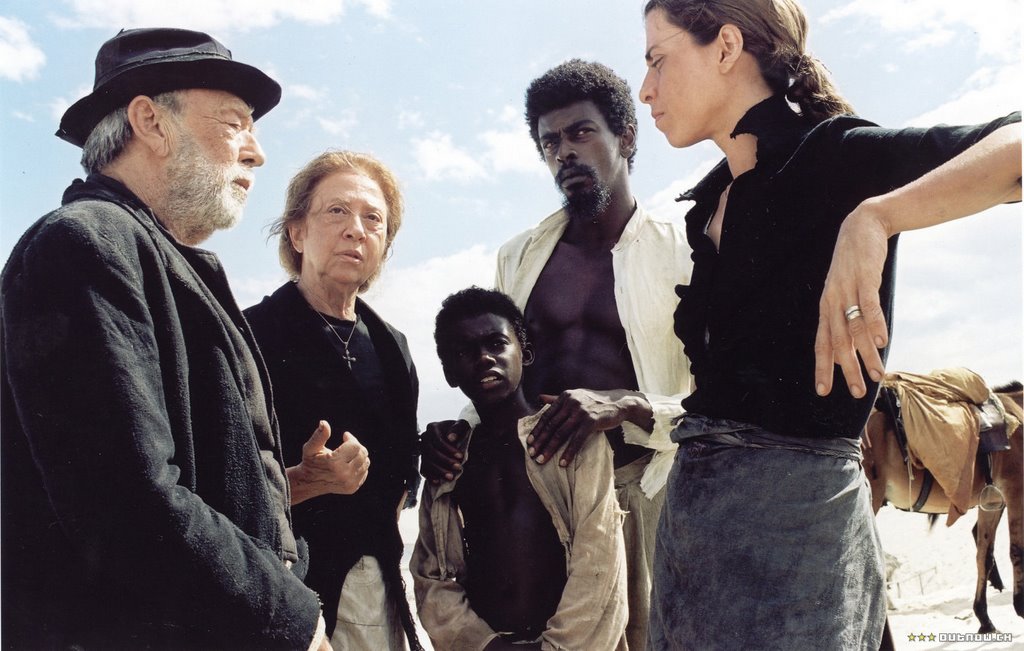
This is the point where The House of Sand fails to lift itself up from merely being an economical film. The film, which deals with a mother-and-daughter relationship spans over more than four decades, is set entirely in a desert, sparing us a swooning cinematography, only to already feel exhausted by the first half of the film.

Yet, the film’s biggest problem lies on the choice of Andrucha Waddington, the director, to cast both leads to play different roles. Arguably, both Fernanda Torres and Fernanda Montenegro are among Brazilian’s finest thespians. However, the risky decision to cast both actresses to play both mothers and daughters within different periods of time prove to be a risk not worth taking at all, for we are hardly convinced with their performance. It is not an easy task to carry different characters within confinement of 2-hour duration, and as a result, we simply do not buy otherwise a great idea. For the actors themselves, what could be a challenging role some actors dream of, simply does not work under a half-baked direction.

Thus, this is the film at its most economical way.

 
Leave a comment

Posted by on 05/27/2006 in English, Film


Heart.

Here are the things you learn from Heart (the movie) that you should apply and consider with your mind, not only relying from your heart (the thing inside your body):

1. a contrived, forced romance should not be made for more than or close to 2-hour long, otherwise any director will run out of tacky lines to utter.
2. running on a tight budget? well, in a matter of film-making, who doesn’t? but sparing the budget for cinematography instead of adding a few necessary cast members is a sin. lucky you, the whole Bandung/Puncak citizen is currently busy tackling their garbage, and not complaining why no one else exists in that area apart from the three main casts.
3. any songs made by melly but not sung by melly should be properly put. where? on the soundtrack album only.
4. if your life is nothing but playing basketball (not even with a team, but just with you yourself and that basketball ring) and painting, here’s my generous advise: get a life!
5. oh, speaking of tacky lines, here’s the thing about teens these days: they are way smarter than that.

Unless we are talking about some hopeless romantics who storm the cinemas, making the film (gasp!) a box-office success. Yes, somehow love-themed stories work best when they despise logic and good quality of filmmaking.

Oh well. I’m out of here.

 
1 Comment

Posted by on 05/26/2006 in English, Film


The Consequences of Love.

Watching a film made from puzzles about one’s life hesitantly scattered pieces by pieces throughout the entire film left one feeling puzzled indeed, in a good way: we get hooked.

The Consequences of Love merely revolves around the life of Titta, an old man with seemingly boring routine. He wakes up, he walks down to a lobby in a hotel where he has been staying in for a number of years. He stays there, reading newspapers until late in the evening when he has to go back to his room to sleep.

Having an almost stationery character like Titta challenges every aspiring filmmaker to bring many additional characters whom Titta will observe, or get involved with. Surely Paolo Sorrentino, the director, follows such a rule, with an underlining bait of his past that soon catches him up. Soon, the past and the present life of Titta will tangle him up, in many ways that thrill our mind, and eyes.

The confinement of space, considering the film is almost entirely set in one location, does not confine Sorrentino from exploring unusual looks which recall any of David Fincher’s works. The carefully captured images in this film is indelible enough to stay on audience’s mind, surely I do, which actually complement the impossibly great twisted screenplay and master-class performance from Tony Servillo as Titta on his commanding presence through stoic manners.

Yet, the film moves, inexplicably.

 
Leave a comment

Posted by on 05/25/2006 in English, Film


The Russian Dolls.

Picking up where The Spanish Apartment leaves us, The Russian Dolls feels fresher, as now the film solely focuses itself on the life of its singular main character, Xavier (Romain Duris in his relaxed performance), particularly in his love department. This means, unlike the predecessor, the film does not have to carry a burden of allocating spaces for multiple characters, which in turn left the first film with a little bit of misled direction.

The focusing does not come with its consequences though, and the one who suffers most from the reduction effect is Audrey Tatou’s character as Xavier’s initial girlfriend, Martine. Halfway throughout the film, the character somehow goes off the film completely, only to be revealed in a lesser scene towards the end, which does not explain or enhance her presence, except to reinstate her annoying charisma built from the beginning.

Photobucket - Video and Image Hosting

Yet, the same cannot be said with Kelly Reilly (that particular shining stripper from Mrs. Henderson Presents) who plays Wendy, Xavier’s English girlfriend. Arguably the only character in the film that breathes full of life, Reilly brings her character in such a charming and likeable manner. Every single turn of her moves, be them as a jealous girlfriend or while hiding her repression of pain, Reilly does them with a believable persona that draws us to her close, rooting for more of her presence.

The rest of returning cast gives a slight brush to the film, which now works as if the audience has graduated from wearing United Colors of Benetton, to a more staple line of Zara. In short, it may not that greatly colorful, but whatever available there are steady ones that will stick to your memory most.

 
1 Comment

Posted by on 05/16/2006 in English, Film


Maskot.

If Maskot feels like a throwback to the good old 70s and early 80s Indonesian comedy, then perhaps Robin Moran, the director, feels the right to do so after watching tremenduous amount of those kind films during the preparation of making his debut film here. Again, it is only a possibility.

Photobucket - Video and Image Hosting

However, the statement above is derived as one can’t help drawing many similarities in this film to the films on the era. At the surface, the basic story premise of Maskot is in many ways applicable as if the film was made by Nja Abbas Acup, Asrul Sani or Chaerul Umam. The film revolves around a search for a hen believed to be the symbol of prosperity for a ketchup company. As the owner of the company (El Manik, in a successive roles required him lying on a hospital bed after his turn in Berbagi Suami) has a declining health, he requests his clumsy son (Ariyo Wahab) to be his successor, but he can only be so if he is able to find that particular hen to be used as a mascot for the factory. Eventually, the search trip has become some sort of coming-of-age journey which resolves in a good way guaranteed to satisfy everyone.

After all, it’s a comedy, right? And good Indonesian comedies of both abovementioned decades, think of Inem Pelayan Sexy, Bintang Kejora and the likes of them, relies on the comic presence of the cast. We are not talking about Bing Slamet, Benyamin S. or Ateng-Iskak films here, where the mere presence of these comic figures would evoke your laughter. Referring to the two aforementioned film, for sure Jalal was on the former film, but hardly any comedy actors present in the latter film, which were filled by character actors such as El Manik, Ikranegara and Amak Baldjun.
Following the similar steps, Moran gave sizable opportunities for the supporting cast of his films to shine. Particularly Butet Kertaradjasa, one of the iconic theatre figures of recent times, and Epi Kusnandar of the TV-series Kejar Kusnadi. Both are able to seize their presence with unique wits and unexpected charm that any scenes without them seem to exhaust themselves.

Thus, in the days of endless mindless teenage romance or horrifying horror, having an Indonesian film that feels Indonesian all around is a refreshing take to indulge.

 
Leave a comment

Posted by on 05/15/2006 in English, Film


Berbagi Suami

With a string of successive records of introductory lessons, Nia DiNata starts to establish her own place among the commonality of other directors in the industry.

Why introductory?

First, she initiates. In Ca-Bau Kan, she brought the unseen historical tale of Chinese heritage to the public for the first time. In Arisan!, she touched the surface of homosexuality to the public unaware of the issue.
The similar pattern continues in her latest effort, Berbagi Suami (literally translated as “Sharing A Husband”, although the official English title is “Love for Share”), and as the title suggests, the film talks about polygamy.

But does the film talk?

Here comes the second point of her directorial trends. She spreads the subject being highlighted, and by doing so, she puts her thoughtful effort to give a politically-correct objective point of view, without necessarily putting in her own belief. Thus, she does not wish to be judgmental or siding to one faith, unlike Oliver Stone in his political series of JFK or Nixon, but rather, she goes for the way Jafar Panahi does The Circle, accommodating as many possible angles as possible, while a little distance away from the likes of, say, The Laramie Project.

It works well, it works not.


The division of the storyline into three (almost) parallel stories, contrasting the risk-and-consequences of polygamy life to one another, gives the audience multiple views of polygamy, leaving the audience choosing on their own. Whether polygamy works by suppressing jealousy, or by leaving the husband for good, or by exploiting every possible chance to make one’s own satisfaction, the effect could not be more satisfying the way a kid is given choices of many flavors in a box of chocolate instead of sticking to one particular flavor.

However, the spread may backlash as it results in the lack of thorough explanation for the subject in focus. This could not be more apparent in the talk-show scene where Salma (played with a great degree of subtlety by Jajang C. Noer) defends her support towards polygamy against her opponent who despises the concept. As the raging discussion continues, while it is still going circle on the facade, DiNata does deus-ex-machina by abruptly inserting the news on tsunami disaster to hijack the whole film throughout, bringing it to another direction.

Which direction will it take then?

The final introductory pattern of DiNata is to leave the audience on their own best to perceive and receive what they see, and perhaps bringing it with them to do any necessary follow-ups on their lives. Certainly Arisan! does not simply end with the two guys embarking on a relationship, and polygamy does not stop when two of four wives leave the man for good.
And maybe this is what DiNata excels best, that in tradition of storyteller, she does not necessarily give the whole story in details. Rather, she tickles her listener by giving a little to think about.

It is understood then that she deserves her own place here.

 
2 Comments

Posted by on 03/26/2006 in English, Film


Ruang.

In the days of successive mindless films only highlighting sophisticated use of advanced technology bombarding the cinemas recently, it is more than welcome to have a film that could transport us back to good old times, when a simple story can be told in a very plain, straightforward manner, yet it leaves us yearning for more.

Even the story is the kind of tale often heard in numerous times. It has been repeated in many versions and many interpretations, yet the way the story is brought to life is sometimes what amazes us, while setting aside the fact we have grown familiar with how the story might end.

It’s not the destination that matters, it’s the journey taken, and how we experience it.

Thus, Ruang gives us the chance to embark on an almost breathless journey from many breathtaking looks displayed on the big screen right in front of our very eyes against the darkened surrounding in a cinema hall. The continuous smooth editing allows us to capture the nuanced atmosphere of the nameless island where the story is set, along with the score, despite often being overplayed, does not glorify or hyperbole the natural beauty to become larger-than-life, but enough to make us feel being taken back to the nostalgia of the past.


The nostalgia theme might be something Teddy Soeriaatmadja has an eye for, as what he previously touched on his previous work, Banyu Biru. But this time, rather than challenging us into the world of surrealism to a raging effect, he wisely penned the script together with Adi Nugroho, making a linear storyline with a crystal clear narrative plot which in turns work pleasantly for us, the audience, and leaving us in amazement. Amazed that only in his second directorial debut, Soeriaatmadja manages to make a successful marriage of filmmaking elements: the technology does not overwhelm the film, but rather, it gives support to a story he has his faith and belief in.

Alas, the story itself does not offer anything new. How many times have we heard and seen a man, in love with a girl he would never be able to have, has to settle for another girl faithfully accompanying him from the beginning without ever asking for anything in return? Such a story does not have any spoilers or twists overtly used in recent films, but to absorb the thematic line, we are not asked to raise our eyebrows to decipher the film.

Because for once, Ruang successfully puts the old-fashioned romance back in a dramatic film we have missed for so long.

 
1 Comment

Posted by on 03/25/2006 in English, Film


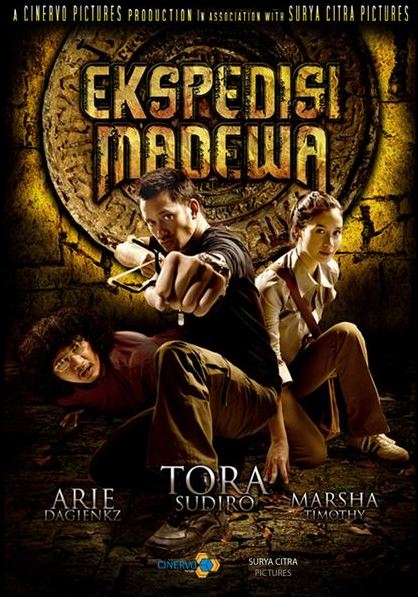
Ekspedisi Madewa

If one starts feeling uncomfortable watching actors in a big screen uncomfortably playing their roles in a film, then the film viewed is in a serious trouble.

Add that with the lack of adequate technical supremacy, something considered vital for the execution of the film here, what do we have then?

We have Ekspedisi Madewa.

The reason why it fails to spark the hysteria of Indiana Jones, as clearly the film is modeled on, can be pointed to many elements. Referring to my point earlier, the star-gazing treatment of a supposedly blockbuster film means that the film is determinedly be carried by a star, or two, as the main attraction. Seeing Tora Sudiro in his static expression throughout many action sequences, as if not sure if he believes in the script that asks him to pull a gun or to climb up, leaves us thinking if he actually screams for help to get him out of the film. Worse, the presence of Arie Dagienkz as the sidekick intended to give the film a fresh air from his humor, falls flat as his joke often seems tepid and unfunny, and not a single scene is able to make him established a character on his own.


Another point to sanctify in this film is its failure to present itself as an action adventure film, to the very least point of getting a proper look. The genre, which relies heavily on the existence of good editing, both in visual and sound department, seems to neglect the crucial technical qualities here. Some unthinkable fatal mistakes, as apparent in shooting the film in a digital camera then blowing it to the big screen, only make us wondering if the experiment of making the film is really disheartening.

Perhaps, the expedition on the subject needs to turn the direction to expedite a proper filmmaking that serves any intended genre, without leaving its audience in unintended confusion.

 
Leave a comment

Posted by on 03/24/2006 in English, Film


Jatuh Cinta Lagi.

Now, let’s play a game of “what-if”.

If Krisdayanti is not a spokesperson for a household product like a washing cream-soap and instead, she goes for, let’s say, a shampoo, will we see a scene filled with nothing but her hair most of the time to state that she is the face of the product and the product is happily inserted on the film?

If the presence of a coffee shop here is replaced by, let’s say, a warung pecel or a hawker centre, will we get to see the women preparing pecel or an uncle bringing us our drinks for a good scene or two, the way we get to see some baristas preparing coffee here in some unrelated scenes?

If Gary Iskak starts acting normally, and understands that being goofy is not the same as being over-the-top annoying, will we ever see the subtlety of playing a male-lead in a romantic comedy the way Hugh Grant or John Cusack easily slip in?

These are merely a few questions flashing through my mind upon watching Jatuh Cinta Lagi, a romantic comedy debut from Rizal Mantovani who revives the horror genre with Jelangkung, but unable to deliver the same revival process to the film here.

Image hosting by Photobucket

The magic does not happen twice in a lifetime, but to think that blatant product placement gets continually annoying our film-watching experience is the least we expect for a prominent director with extensive video-music making background as of him.

Thus, when we start to look for something else to satisfy our thirst of the genre, again the mission is aborted by the unconvincing turns of the leads. As a female lead, Krisdayanti does not have enough potent to be kooky and smart at the same time as required by her character as a lawyer her, and she has to settle for the former quality which does not work all the time. Iskak has an aforementioned problem which suspiciously rooted from his own misconception of acting in a comedy film, instead of a romantic comedy one. Endhita as the female lead’s best friend, a possible side-kick that could have stolen the film, instead got stolen by the lines she had to utter. Her delivery of dialogues lacks the wit much needed in her presence, thus leaving her smart lines as prepared by the scriptwriter, Ve Handojo, gone off in the dust.

The only revelation is seeing Cornelia Agatha, fresh from her depressive performance in Detik Terakhir. Her kooky turn as an attention-seeker dangdut singer is exhilarating, thanks to her ability in maintaining her comic timing in place, and despite having to act against the leads, Agatha could hijack the film at any given time.

Thankfully, Mantovani keeps her in tact, leaving Agatha’s scenes short but memorable enough to leave us thinking about the film with a smile.

Just don’t get start on that little thing called BuKrim here …

 
Leave a comment

Posted by on 03/23/2006 in English, Film


Jomblo.

(For the purpose of any non-Indonesian speakers out there, the title can be loosely translated as a singleton, and the word applies to both sexes, although the film largely focuses on the single guys.)

Ooppss! Have I said too much above?

I can’t help it, as much as I can’t help laughing, smiling, smirking, thinking, wondering, and other activities done by a film audience who is fully amused with a film that, despite some bumpy rides towards the end, is consistently entertaining.

Jomblo, with a line-up of four straight single guys desperately wanting to get girlfriends by their sides, may tempt a comparison being a male version of Sex and the City, and make the setting changed from Manhattan to some fictional universities in Bandung instead. No famous clothing line flashing on the screen, but we settle for a staple of T-shirt and jeans, emphasizing the look of regular college guys who less bother about their looks.

That’s why, the move of Hanung Bramantyo, the director, to cast the lead in relatively unknown newcomer, Ringgo Agus Rahman, is something worth a praise on its own, as Ringgo carries his role as Agus, the guy who walks away with his wrongdoings, in a relaxed manner, unpretentious that we enjoy his quirky acts without having to laugh at him. Instead, we laugh with him when he appears in his chicken costume, or when he reaches his peak of desperation to get a strap of condoms.

Such a joke which often being banally used in many slapstick comedies of Warkop DKI in late 1980s works pleasantly well under a script which seems to be carefully written by the director himself, along with Adhitya Mulya who also pens Jomblo, the novel, in which the film is based from.

Image hosting by Photobucket

If anything bugs me most, is none other than the stoic presence of Rizky Hanggono, somewhat often stumbling down amidst his fellow members of this ensemble cast that comprises of Ringgo, Dennis Adhiswara who shamelessly goes to extra length in making a fun of himself, and Christian Sugiono. The latter himself is suspiciously cast to the credit of his good look, but even so, the quality fits his role as a playboy nicely, thus his presence is a far cry from being an annoyance likely found in many other flicks.

With clean slate of humor, often teasing with sex subject without being gross, and the characters Indonesians could easily relate to, it is hardly any doubt that the film is as a complete as what a good, entertaining Indonesian teen-flick should look like.

 
Leave a comment

Posted by on 03/22/2006 in English, Film


Match Point.

What can we say of Woody Allen who does London?

What I can say about him and his latest film here is to imagine him in his reclusive semi-retirement in a countryside of London, enjoying his fine wine while recalling the good old memories of his glory, and when he does that, he really picks up the good ones to be assembled in a collective work of art. A piece that is worth of an appreciation on its own.

For an afficionado of his works from the days of Take The Money and Run to the recent years of Small Time Crooks, we hardly hold any surprise to what Match Point offers.
But for those less familiar with his past days, seeing the film is still a pleasure very likely to bring them to understand Allen’s stature position in cinematic world, and that position reflects his wit and philosophical mind-games that most of the time would surely jolt us, shaking our heads in disbelief over seeing an otherwise illicit soap-opera drama into a highly praised thriller which goes deeper as a study of human behavior in general.


The object of the study lies on the presence of Jonathan Rhys-Meyers as a tennis pro has-been who chameleons himself as a desperate social climber, only to hit the jackpot when he strikes a winning game by marrying Emily Mortimer of a reputable family. Thus, begins the question of morale Allen starts asking us: for a climber to reach the top of his destination, is there any limit to the ladder he climbs?

Apparently, the answer points to an indefinite limit of the ladder, as now the climb is heading towards the sultry Scarlett Johansson, a deadly viper, femme fatale, who, in the tradition of Barbara Stanwyck in Double Indemnity or Lana Turner in The Postman Always Rings Twice, is able to mastermind and take over the control from the hapless guy now being a victim himself.

Or is he?

Allen has done this earlier in his Crimes and Misdemeanors, to a much more mind-blowing result, yet that does not mean leaving Match… in a pale comparison, for this London film has its own sleek look, suspiciously resulted from Allen’s shift in his musical score from the usual old-school jazz to classical opera, something to enhance the elegance of the upper-class society portrayed here.
But above all, what distinguishes the film from Allen’s recent works is his ability to leave out his ego completely on the screen, leaving the film with a fresh feeling, as if, hyperbolically, Allen is reborn in the film world. Hardly any single character in this film that we could say, “That’s so Woody!”, unlike, say, Anything Else in which Jason Biggs does Allen at his younger days (to a horrifying effect, Allen himself appears in that film!), and even Crimes… featured Allen in one of the main roles.

Perhaps London air does him good, leaving the spotlight to the beaming greatness of the cast, in particular Johansson who dons her sexy persona to the role she carries and continues haunting the film even when her character rarely presents in the film. Allen himself orchestrates them from behind, giving them deft direction from the clearly-twisted script he pens.

Thus, if London does muse him this well, we look forward to having more of it.

 
Leave a comment

Posted by on 03/21/2006 in English, Film


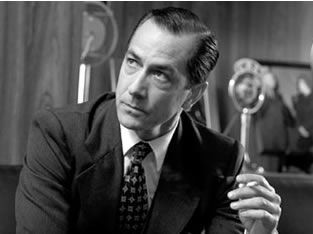
Good Night, and Good Luck.

I wonder if there is any film in recent years that beguile you from the start, and in reflect you give a thunderous clap after every single speech delivered by the main character.

If a statement above seems hyperbolic, then perhaps because the title film on our subject is. Or rather, it is larger than life.

The sophomore directorial debut of George Clooney exactly mirrors his own persona: charming, suave and contented. Thus, when he delivers the subject of television journalism serving as a merciless attack towards the communist witch-hunt initiated by Senator Joseph McCarthy in 1950s, Clooney shows that such a resilient persistence has to be done in a grand manner.

The manner is apparent enough through the, literally, smoky screen as we see the main characters continue puffing their way through cigarettes, perhaps symbolizing the perceived image of gentlemen of that era. The backdrop jazz soundtrack provided by Dianne Reeves remind us the insert of Vonda Shepard in Ally McBeal series, that although the presence is considered a background prop, no scenes are wasted whenever they are in.
The combination of the two leads to the gorgeous black-and-white cinematography of Robert Elswit, a deserving Oscar-nominee for his work here, providing illuminous look against the constant terror in the television studio as told to us through a compelling screenplay.


The words as spoken in attention-grabbing style of David Strathairn as Edward R. Murrow are indeed echoing the importance of a goggle box called television. Thus, towards the end of the film, after showcasing his star persona in every single scene, Murrow closes his exhibition by giving a toned-down speech, indicating that it is not the television that stupefying us, but rather, how we treat the box as a tool to enhance our mind and our knowledge towards life.

It is by then, a suaver-than-suave persuasion from a person like Clooney can pull it off nicely in this best journalism drama in recent years.

Alas, a film as good as this will leave you wanting for more, long after the closing speech ends with:

Good Night, and Good Luck..

 
Leave a comment

Posted by on 03/20/2006 in English, Film


Rent.

As the song Seasons of Love literally opens the curtain, revealing lush spotlights highlighting a group of bohemians in New York dealing with their lives against AIDS and other social injustice, we are soon to be taken to a world of (another) disbelief: with such a promising material that makes the Broadway play in which the film is originated from is a hit, why the film goes downhill right after the compelling first 10 minutes?
Worse, having the original cast aboard, with the exception of Rosario Dawson, why the film seems a tad lengthy, and that’s not even compliment?

If we wish to draw the same line with the butchering treatment of The Phantom of the Opera last year, then we directly come to conclusion that it takes a specially gifted director to direct a musical adaptation, or it can also be said that those qualified to bring a stage musical into a big screen are the ones who are deft enough in understanding the complexity of stage, and able to bridge the gap of stage and screen.

In a snapshot, Rob Marshall and Baz Luhrmann fit the above description nicely, and so was Bob Fosse. On the other hand, Joel Schumacher failed to bring the magical quality of the Andrew Lloyd Webber’s sacred opera, and this year, Chris Columbus follows in his step to the same miserable effect.


The problem Rent obviously has is that as a film, it does not give enough space to breathe. Similar to Evita where every single song is belting out one after another in many almost static scenes that may work on stage but definitely not on a big screen, we hardly relate to their yearnings despite desperately compelling performances from the cast. Whereas the concept might work for Umbrellas for Cherbrough, the effectiveness is largely credited to Jacques Demy’s adequateness in creating a pleasant-to-look-at atmosphere imbued in his colorful cinematography, something lacking in Columbus’s film which tends to focus on the slum side of New York.

Not that it bogs down the well-conceived story, but rather, the lack of rich variety in the look of the film is another questionable quality of Columbus who previously gained acclaims in giving birth to Harry Potter series in almost gothic presentation, which works surprisingly well.

Alas, despite the tear-jerker moments derived from the original stage plot, the film might pull a teardrop or two, yet by the time we leave the theater, we will be left with a vague reminiscent that within Seasons of Love, lies a passing train, too fast for us to even notice the train’s passengers, who are more than capable in giving us a ride of a lifetime. Too bad we do not hop on it.

 
Leave a comment

Posted by on 03/13/2006 in English, Film


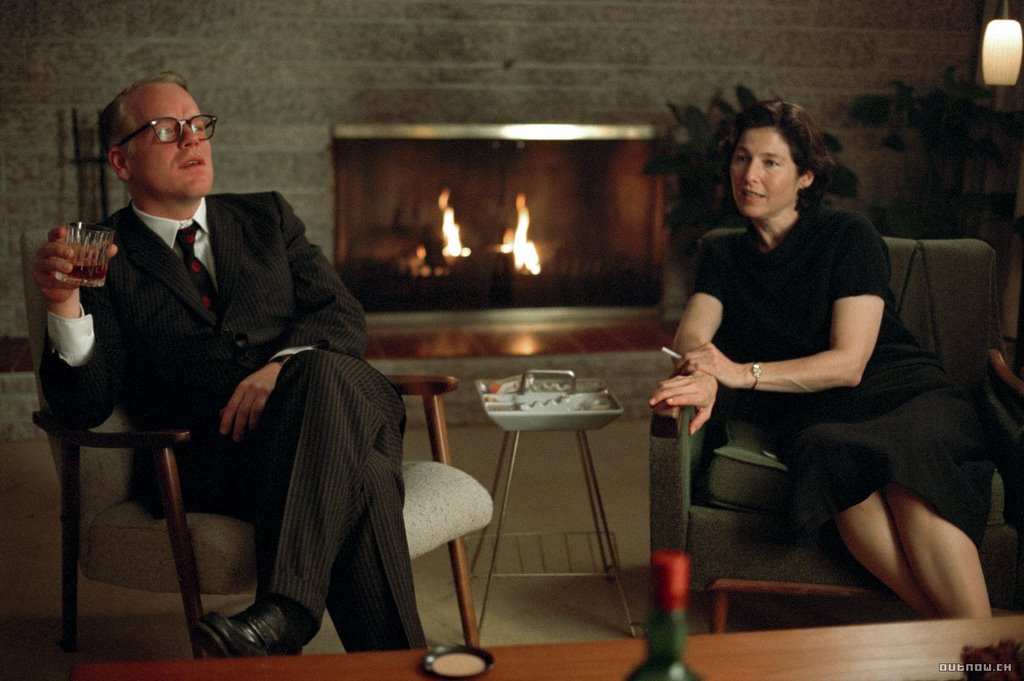
Capote.

One sentence to describe Capote, the film, is that it is beautifully acted by its lead, Phillip Seymour Hoffman.

In a tradition of biopic films with the title directly indicating the subject, strong and believable performances are the main essential to capture the stark truth personality often hidden under the face value. Ray and Jamie Foxx are two inseparable units, when we see Foxx on the big screen marching through the decades of the famed musician’s tumultuous life, we see a live version of Ray Charles himself, retelling the story and the carrying the persona as is. Almost.

In less than a year, the benchmark is elevated by Hoffman in his stellar portrayal of the famous author who at any given time was more than willing to do anything to make him, puns intended, infamous. The first scene set on a train when he paid a porter to praise him in front of his close friend, Nelle (played with soothing manner by always reliable Catherine Keener), both shows his yearning for attention while also emphasizing his arrogance of intellect and social status. While we are taken to every single disbelieving acts of his doings, Hoffman constantly pushes himself in hardly mimicking the elusive style of Capote, but often terrify the bemused audience in wondering, if Hoffman literally gets the character he is playing under his own skin.
The toughness of the role painstakingly brings to life by Hoffman, earning our admiration and respect despite many despicable acts of Capote in exploiting his subjects, particularly to the inmates he nurtured in the book he was working on in the film, which later became his most famous work, In Cold Blood.

Thus, the class-act could not happen had it not been for the very focused script by Dan Futterman and the deft direction of Bennett Miller in bringing up the story that circles within the period of 6 years in Capote’s life of making the book. The limited time span allows further probe of a person’s life rather than condensing a span of a lifetime in limited time of 2 hours, which often unfairly cut out some essential parts in the noted life, and not to mention that specified time span will enable the actor playing the role to transform himself gradually without necessarily rushing from one make-up change to another, something that might actually endanger the film’s brilliance had it been conceptualized that other way.

For sure, some limitation enables one to focus sharply, just like what the film does, and never us as audience gets deterred througout watching the entire film. This is a brilliant biopic.

 
Leave a comment

Posted by on 03/12/2006 in English, Film


Tsotsi.

Why Tsotsi fails to amuse me?

Because he does not belong specifically to South Africa, that’s why.

Following his journey of a life-changing experience happens to be set against the backdrop of a slum area in South Africa, we begin to wonder, if the backdrop is changed to anywhere else, particularly Bronx, USA, will the story remain the same?

In this case the answer is an unfortunate yes.

Not that it will prevent tears from dropping when we see some tender scenes between Tsotsi, his stolen baby and his breast-feeding mother, but in the era of distinctive qualities of being a film made overseas (read: outside Hollywood or USA), the film lacks of any quality that makes it different from any other films made within the system of Hollywood.

Image hosting by Photobucket

As such, the film suffers greatly from the usual formula often seen in any other films, that redemption comes to end, and our hopeless anti-hero has to surrender to the system he cannot challenge. The formulaic storyline has been told many times, be them in Hollywood or not, and Tsotsi has to unfairly be put in the shadows of those similar works.

If anything else is considered a redemptive quality, it is the performance of the leading actor, Presley Chweneyagae, who carries the role, surprisingly, with often static expression that most of the time works well to convey the intended aching response we ought to have.

After all, there’s gotta be a reason why he carries the title role.

 
Leave a comment

Posted by on 03/11/2006 in English, Film